holds, where the discrete function is plotted above. The high-water marks for occur for , 2, and 4, with , with no larger
value among the first primes. Since the Andrica
function falls asymptotically as increases, a prime gap of ever
increasing size is needed to make the difference large as becomes large. It therefore seems highly likely the conjecture
is true, although this has not yet been proven.
bears a strong resemblance to the prime difference
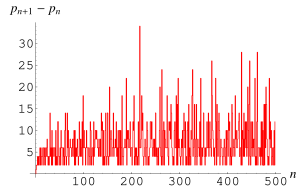
function, plotted above, the first few values of which are 1, 2, 2, 4, 2, 4,
2, 4, 6, 2, 6, ... (OEIS A001223).
A generalization of Andrica's conjecture considers the equation
and solves for . The smallest such is (OEIS A038458),
known as the Smarandache constant, which
occurs for
and
(Perez).


 the
 th prime number, the inequality

 is plotted above. The high-water marks for
 occur for
 , 2, and 4, with
 , with no larger
value among the first
 primes. Since the Andrica
function falls asymptotically as
 increases, a prime gap of ever
increasing size is needed to make the difference large as
 becomes large. It therefore seems highly likely the conjecture
is true, although this has not yet been proven.
 bears a strong resemblance to the prime difference
function, plotted above, the first few values of which are 1, 2, 2, 4, 2, 4,
2, 4, 6, 2, 6, ... (OEIS A001223).

 . The smallest such
 is
 (OEIS A038458),
known as the Smarandache constant, which
occurs for
 and
 (Perez).
