


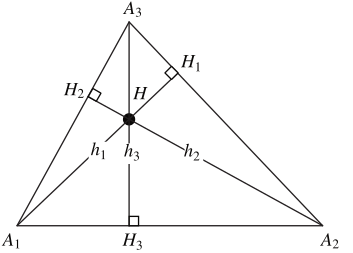
The altitudes of a triangle are the Cevians  that are perpendicular
to the legs
 opposite
 . The three altitudes of any
triangle are concurrent
at the orthocenter
 (Durell 1928). This fundamental fact did not appear anywhere
in Euclid's Elements.
The triangle  connecting the feet of the altitudes is known as the orthic
triangle.
The altitudes of a triangle with side length  ,
 ,
and
 and vertex angles
 ,
 ,
 have lengths given by
 |  |  |
(1)
|
 |  |  |
(2)
|
 |  |  |
(3)
|
where  is the circumradius
of
 . This leads to the beautiful formula
 |
(4)
|
Other formulas satisfied by the altitude include
 |
(5)
|
where  is the inradius,
and
 |  |  |
(6)
|
 |  |  |
(7)
|
 |  |  |
(8)
|
where  are the exradii
(Johnson 1929, p. 189). In addition,
 |  |  |
(9)
|
 |  |  |
(10)
|
 |  |  |
(11)
|
where  is again the circumradius.

The points  ,
 ,
 ,
and
 (and their permutations with respect
to indices; left figure) all lie on a circle, as do the
points
 ,
 ,
 ,
and
 (and their permutations with respect
to indices; right figure).
Triangles  and
 are inversely similar.
Additional properties involving the feet of the altitudes are given by Johnson (1929, pp. 261-262). The line joining the feet to two altitudes of a triangle is antiparallel to the third side (Johnson 1929, p. 172).
