

The Elements is the classic treatise in geometry written by Euclid and used as a textbook for more than  years in western Europe. An Arabic version The Elements
appears at the end of the eighth century, and the first printed version was produced
in 1482 (Tietze 1965, p. 8). The Elements, which went through more than
years in western Europe. An Arabic version The Elements
appears at the end of the eighth century, and the first printed version was produced
in 1482 (Tietze 1965, p. 8). The Elements, which went through more than
 editions and consisted of 465 propositions, is divided into 13 "books" (an
archaic word for "chapters").
editions and consisted of 465 propositions, is divided into 13 "books" (an
archaic word for "chapters").
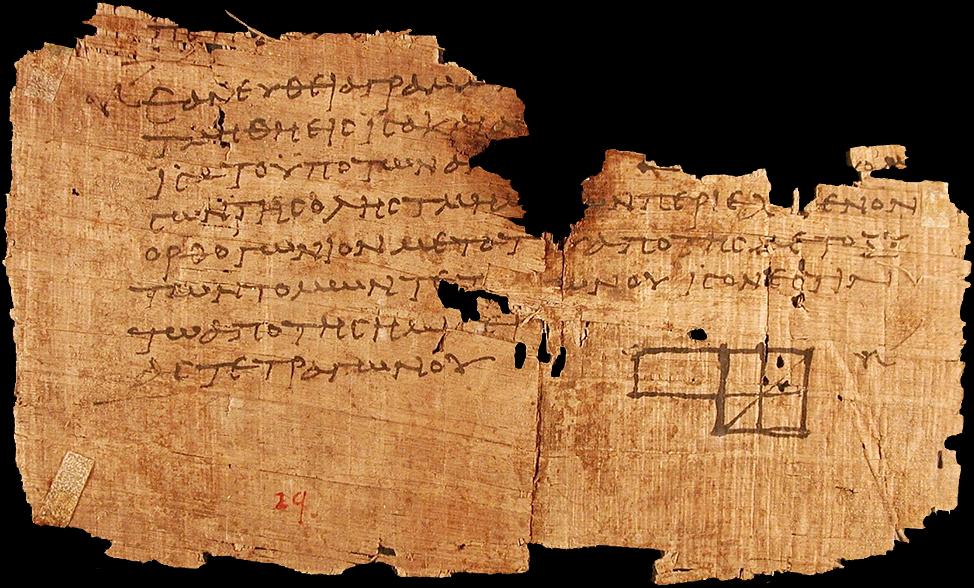
A papyrus fragment discovered at Oxyrhynchus, an ancient city in Middle Egypt at the site of modern el-Bahnasa, dates to about 75-125 AD and contains one of the oldest known complete diagrams from the Elements, together with the statement of Book II, proposition 5. The fragment is now held by the Penn Museum in Philadelphia as object E2748. In modern notation, the proposition expresses the algebraic identity
 |
(History of Mathematics Project).
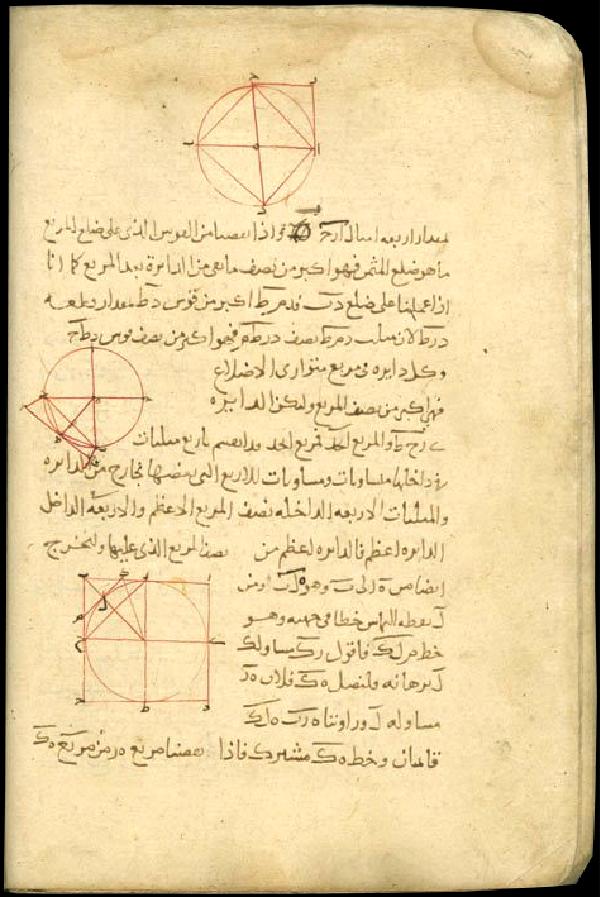
Nasir al-Din al-Tusi completed an Arabic recension of the Elements in 1248. Its first 13 books follow the structure of Euclid's work, while its last two books are identified as later additions not written by Euclid and are attributed to Hypsicles of Alexandria. A 1258 manuscript copy is now held by the British Library in London as Add MS 23387 (History of Mathematics Project).
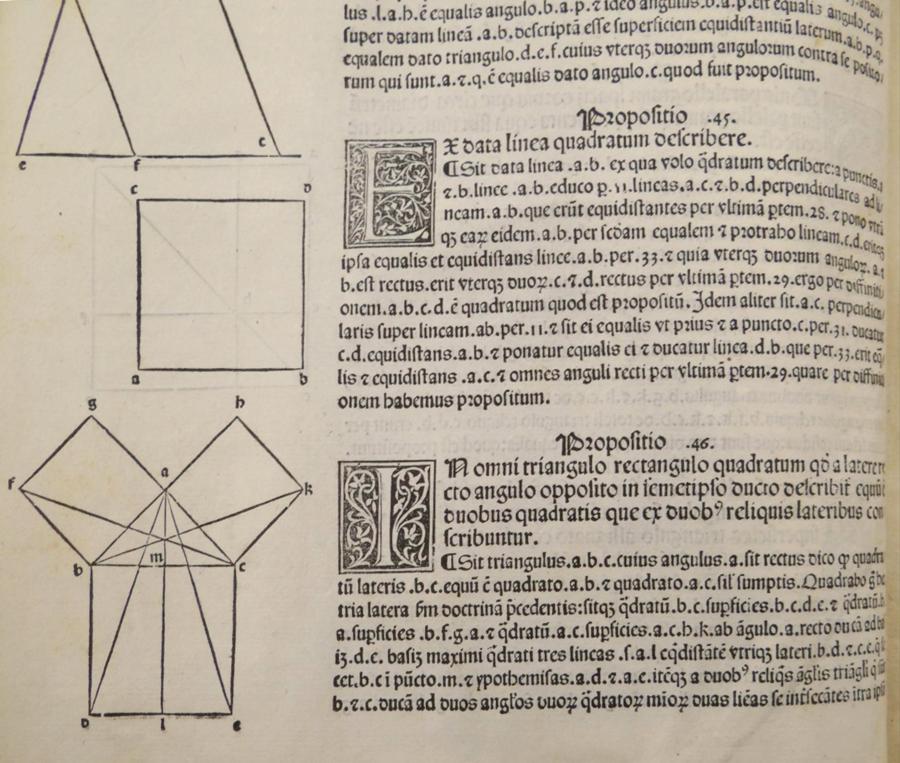
That first printed edition was produced by Erhard Ratdolt from a Latin text transmitted through Adelard of Bath and Campanus of Novara. It contained 15 books, of which Book XIV is attributed to Hypsicles and Book XV to an unnamed sixth-century Roman surveyor. The copy is now held by the Linda Hall Library of Science, Engineering & Technology in Kansas City as QA31.E8587 1482 (History of Mathematics Project).
| book | contents |
| 1 | triangles |
| 2 | rectangles |
| 3 | circles |
| 4 | polygons |
| 5 | proportion |
| 6 | similarity |
| 7-10 | number theory |
| 11 | solid geometry |
| 12 | pyramids |
| 13 | Platonic solids |
The Elements started with 23 definitions, five postulates, and five "common notions," and systematically built the rest of plane geometry and solid geometry upon this foundation. The five Euclid's postulates are
1. It is possible to draw a straight line from any point to another point.
2. It is possible to produce a finite straight line continuously in a straight line.
3. It is possible to describe a circle with any center and radius.
4. All right angles are equal to one another.
5. If a straight line falling on two straight lines makes the interior angles on the same side less than two right angles, the straight lines (if extended indefinitely) meet on the side on which the angles which are less than two right angles lie.
(Dunham 1990). Euclid's fifth postulate is known as the parallel postulate. After more than two millennia of study, this postulate was found to be independent of the others. In fact, equally valid non-Euclidean geometries were found to be possible by changing the assumption of this postulate. Unfortunately, Euclid's postulates were not rigorously complete and left a large number of gaps. Hilbert needed a total of 20 postulates to construct a logically complete geometry.
