

Abel's addition theorem reduces a sum of integrals of a fixed algebraic function to a bounded number
of integrals of the same function, together with an
elementary function of the original endpoints.
If the associated algebraic curve has curve
genus  , then, modulo periods arising from closed integration
paths,
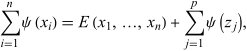 |
where  is an Abelian integral, the
 are algebraic functions
of the
 , and
 is a combination of algebraic
functions and their logarithms (Kleiman 2004).
Choices of paths and branches are understood in this statement.
For elliptic integrals,  , so only one integral
remains, as in Euler's addition theorem.
The related Abel's curve theorem concerns sums
taken over intersections with a varying auxiliary algebraic
curve (Kleiman 2004).
