TOPICS
Search

Euler's Addition Theorem


Euler's addition theorem for elliptic integrals states that, with g(x)=(1-x^2)(1-k^2x^2),

 int_0^a(dx)/(sqrt(g(x)))+int_0^b(dx)/(sqrt(g(x)))=int_0^c(dx)/(sqrt(g(x))),
(1)

where

 c=(bsqrt(g(a))+asqrt(g(b)))/(1-k^2a^2b^2).
(2)

For real variables with 0<=k<1 and -1<a,b<1, use positive square roots and require the sum of the two integrals to lie between -K(k) and K(k), where K is the complete elliptic integral of the first kind. The formula follows from the addition identity for the Jacobi elliptic function sn(u,k) (DLMF 22.8.1).

A form of Euler's differential equation is the separable differential equation
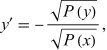
 y^'=-(sqrt(P(y)))/(sqrt(P(x))),
(3)

where P is a polynomial of degree at most four (Euler 1761, §30). On real intervals where P is positive, take positive square roots. If F^'(u)=1/sqrt(P(u)), separation gives F(x)+F(y)=C for a constant C. The addition theorem above gives this sum as F(c) when P=g, F(0)=0, x=a, and y=b.


See also

Abel's Addition Theorem, Elliptic Integral of the First Kind, Jacobi Elliptic Functions

Explore with Wolfram|Alpha

References

Euler, L. "De integratione aequationis differentialis (mdx)/sqrt(1-x^4)=(ndy)/sqrt(1-y^4)." Novi Comment. Acad. Sci. Imp. Petropol. 6, 37-57, 1761. https://scholarlycommons.pacific.edu/euler-works/251/.NIST Digital Library of Mathematical Functions. "Addition Theorems." https://dlmf.nist.gov/22.8.

Referenced on Wolfram|Alpha

Euler's Addition Theorem

Cite this as:

Weisstein, Eric W. "Euler's Addition Theorem." From MathWorld--A Wolfram Resource. https://mathworld.wolfram.com/EulersAdditionTheorem.html

Subject classifications


