The roots (sometimes also called "zeros") of an equation
are the values of
for which the equation is satisfied.
Roots which belong to certain sets
are usually preceded by a modifier to indicate such, e.g., is called a rational root, is called a real root, and is called a complex root.
The fundamental theorem of algebra states that every polynomial equation of degree
has exactly complex roots, where some roots may have a multiplicity greater
than 1 (in which case they are said to be degenerate). In the Wolfram
Language, the expression Root[p(x),
k] represents the th
root of the polynomial, where , ...,
is an index indicating the root number in the Wolfram
Language's ordering.
The roots of a complex function can be obtained by separating it into its real and imaginary plots and plotting these curves (which are related by the Cauchy-Riemann
equations) separately. Their intersections give the complex roots of the original
function. For example, the plot above shows the curves representing the real and
imaginary parts of ,
with the three roots indicated as black points.
Householder (1970) gives an algorithm for constructing root-finding algorithms with an arbitrary order of convergence. Special root-finding techniques can often be applied
when the function in question is a polynomial.


 for which the equation is satisfied.
 which belong to certain sets
are usually preceded by a modifier to indicate such, e.g.,
which belong to certain sets
are usually preceded by a modifier to indicate such, e.g.,  is called a rational root,
  is called a real root, and
  is called a complex root.
 has exactly
  complex roots, where some roots may have a multiplicity greater
than 1 (in which case they are said to be degenerate). In the Wolfram
Language, the expression Root[p(x),
k] represents the
complex roots, where some roots may have a multiplicity greater
than 1 (in which case they are said to be degenerate). In the Wolfram
Language, the expression Root[p(x),
k] represents the  th
root of the polynomial
th
root of the polynomial  , where
  , ...,
  is an index indicating the root number in the Wolfram
Language's ordering.
is an index indicating the root number in the Wolfram
Language's ordering.
 th
root"
th
root"  of a complex
number
of a complex
number  is known as an nth
root.
is known as an nth
root.
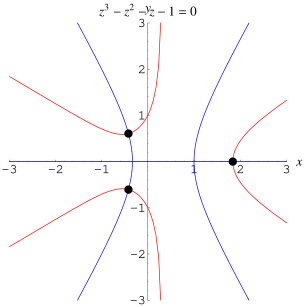
 ,
with the three roots indicated as black points.
,
with the three roots indicated as black points.
