


Given a number  ,
the cube root of
,
the cube root of  ,
denoted
,
denoted ![RadicalBox[z, 3]](/images/equations/CubeRoot/Inline3.svg) or
or  (
( to the 1/3 power), is a number
  such that
  . The cube root is therefore an nth
root with
. The cube root is therefore an nth
root with  .
Every real number has a unique real cube root, and every nonzero complex number has
three distinct cube roots.
.
Every real number has a unique real cube root, and every nonzero complex number has
three distinct cube roots.
The schoolbook definition of the cube root of a negative number is 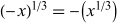 . However, extension of the cube root into
the complex plane gives a branch
cut along the negative real axis for the principal
value of the cube root as illustrated above. By convention, "the" (principal)
cube root is therefore a complex number with positive
imaginary part. As a result, the Wolfram
Language and other symbolic algebra languages and programs that return results
valid over the entire complex plane therefore return complex results for
. However, extension of the cube root into
the complex plane gives a branch
cut along the negative real axis for the principal
value of the cube root as illustrated above. By convention, "the" (principal)
cube root is therefore a complex number with positive
imaginary part. As a result, the Wolfram
Language and other symbolic algebra languages and programs that return results
valid over the entire complex plane therefore return complex results for  . For example, in the Wolfram
Language, ComplexExpand[(-1)^(1/3)]
gives the result
. For example, in the Wolfram
Language, ComplexExpand[(-1)^(1/3)]
gives the result 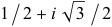 .
.
When considering a positive real number  , the Wolfram Language
function CubeRoot[x],
which is equivalent to Surd[x,
3], may be used to return the real cube root.
, the Wolfram Language
function CubeRoot[x],
which is equivalent to Surd[x,
3], may be used to return the real cube root.
The cube root of a number  can be computed using Newton's method by iteratively
applying
can be computed using Newton's method by iteratively
applying
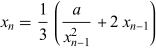 |
for some real starting value  .
.
