A definite integral is an integral
 |
(1)
|
with upper and lower limits. If  is restricted to lie on the real
line, the definite integral is known as a Riemann
integral (which is the usual definition encountered in elementary textbooks).
However, a general definite integral is taken in the complex plane, resulting in
the contour integral
is restricted to lie on the real
line, the definite integral is known as a Riemann
integral (which is the usual definition encountered in elementary textbooks).
However, a general definite integral is taken in the complex plane, resulting in
the contour integral
 |
(2)
|
with  ,
,
 , and
, and  in general being complex numbers and the path of integration
from
in general being complex numbers and the path of integration
from  to
to  known as a contour.
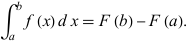
The first fundamental theorem of calculus allows definite integrals to be computed in terms of indefinite
integrals, since if  is the indefinite integral
for a continuous function
is the indefinite integral
for a continuous function  , then
 |
(3)
|
This result, while taught early in elementary calculus courses, is actually a very deep result connecting the purely algebraic indefinite
integral and the purely analytic (or geometric) definite integral. Definite integrals
may be evaluated in the Wolfram Language
using Integrate[f,
 x, a, b
 ].
].
The question of which definite integrals can be expressed in terms of elementary functions is not susceptible to any established theory. In fact, the problem
belongs to transcendence theory, which appears to be "infinitely hard."
For example, there are definite integrals that are equal to the Euler-Mascheroni
constant  .
However, the problem of deciding whether
.
However, the problem of deciding whether  can be expressed in terms of the values at rational values
of elementary functions involves the decision
as to whether
can be expressed in terms of the values at rational values
of elementary functions involves the decision
as to whether  is rational or algebraic, which is not known.
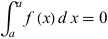
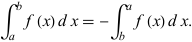
Integration rules of definite integration include
 |
(4)
|
and
 |
(5)
|
For  ,
,
 |
(6)
|
If  is continuous on
 ![[a,b]](/images/equations/DefiniteIntegral/Inline16.svg) and
and  is continuous and has an antiderivative on an interval
containing the values of
is continuous and has an antiderivative on an interval
containing the values of  for
for  , then
 |
(7)
|
Watson's triple integrals are examples of (very) challenging multiple integrals. Other challenging integrals include Ahmed's integral and Abel's integral.
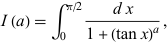
Definite integration for general input is a tricky problem for computer mathematics packages, and some care is needed in their application to definite integrals. Consider the definite integral of the form
 |
(8)
|
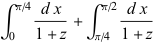
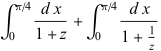
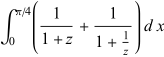
which can be done trivially by taking advantage of the trigonometric identity
 |
(9)
|
Letting  ,
,
 |  |  |
(10)
|
 |  |  |
(11)
|
 |  |  |
(12)
|
 |  |  |
(13)
|
 |  |  |
(14)
|
Many computer mathematics packages, however, are able to compute this integral only for specific values of  , or not at all. Another example that is difficult for computer
software packages is
, or not at all. Another example that is difficult for computer
software packages is
![int_(-pi)^piln[2cos(1/2x)]dx=0,](/images/equations/DefiniteIntegral/NumberedEquation10.svg) |
(15)
|
which is nontrivially equal to 0.
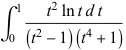
Some definite integrals, the first two of which are due to Bailey and Plouffe (1997) and the third of which is due to Guénard and Lemberg (2001), which were identified by Borwein and Bailey (2003, p. 61) and Bailey et al. (2007, p. 62) to be "technically correct" but "not useful" as computed by Mathematica Version 4.2 are reproduced below. More recent versions of Wolfram Language return them directly in the same simple form given by Borwein and Bailey without even the need for additional simplification:
 |  |  |
(16)
|
 |  |  |
(17)
|
 |  |  |
(18)
|
 |  |  |
(19)
|
 |  |  |
(20)
|
 |  |  |
(21)
|
(OEIS A091474, A091475, and A091476), where  is Catalan's constant.
A fourth integral proposed by a challenge is also trivially computable in modern
versions of the Wolfram Language,
is Catalan's constant.
A fourth integral proposed by a challenge is also trivially computable in modern
versions of the Wolfram Language,
 |  |  |
(22)
|
 |  |  |
(23)
|
(OEIS A091477), where  is Apéry's constant.
A pretty definite integral due to L. Glasser and O. Oloa (L. Glasser, pers. comm., Jan. 6, 2007) is given by
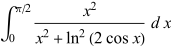 |  | ![1/8pi[1-gamma+ln(2pi)]](/images/equations/DefiniteIntegral/Inline65.svg) |
(24)
|
 |  |  |
(25)
|
(OEIS A127196), where  is the Euler-Mascheroni
constant. This integral (in the form considered originally by Oloa) is the
is the Euler-Mascheroni
constant. This integral (in the form considered originally by Oloa) is the  case of the class of integrals
 |
(26)
|
previously studied by Glasser. The closed form given above was independently found by Glasser and Oloa (L. Glasser, pers. comm., Feb. 2, 2010; O. Oloa, pers. comm., Feb. 2, 2010), and proofs of the result were subsequently published by Glasser and Manna (2008) and Oloa (2008). Generalizations of this integral have subsequently been studied by Oloa and others; see also Bailey and Borwein (2008).
An interesting class of integrals is
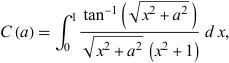 |
(27)
|
which have the special values
 |  |  |
(28)
|
 |  |  |
(29)
|
 |  |  |
(30)
|
(Bailey et al. 2007, pp. 42 and 60).
An amazing integral determined empirically is
![2/(sqrt(3))int_0^1(ln^6xtan^(-1)((xsqrt(2))/(x-2)))/(x+1)dx=1/(81648)[-229635L_3(8)+29852550L_3(7)ln3-1632960L_3(6)pi^2+27760320L_3(5)zeta(3)-275184L_3(4)pi^4+36288000L_3(3)zeta(5)-30008L_3(2)pi^6-57030120L_3(1)zeta(7)],](/images/equations/DefiniteIntegral/NumberedEquation13.svg) |
(31)
|
where
 |  | 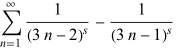 |
(32)
|
 |  | ![1/(3^s)[zeta(s,1/3)-zeta(s,2/3)]](/images/equations/DefiniteIntegral/Inline85.svg) |
(33)
|
(Bailey et al. 2007, p. 61).
A complicated-looking definite integral of a rational function with a simple solution is given by
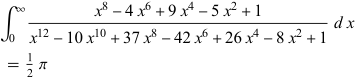 |
(34)
|
(Bailey et al. 2007, p. 258).
Another challenging integral is that for the volume of the Reuleaux tetrahedron,
 |  | ![int_0^1[(8sqrt(3))/(1+3t^2)-(16sqrt(2)(3t+1)(4t^2+t+1)^(3/2))/((3t^2+1)(11t^2+2t+3)^2)-(sqrt(2)(249t^2+54t+65))/((11t^2+2t+3)^2)]dt](/images/equations/DefiniteIntegral/Inline88.svg) |
(35)
|
 |  |  |
(36)
|
 |  |  |
(37)
|
(OEIS A102888; Weisstein).
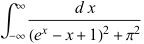
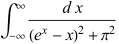
Integrands that look alike could provide very different results, as illustrated by the beautiful pair
 |  |  |
(38)
|
 |  |  |
(39)
|
 |  |  |
(40)
|
due to V. Adamchik (OEIS A115287; Moll 2006; typo corrected), where  is the omega constant
and
is the omega constant
and  is the Lambert W-function. These can
be computed using contour integration.
is the Lambert W-function. These can
be computed using contour integration.
Computer mathematics packages also often return results much more complicated than necessary. An example of this type is provided by the integral
 |
(41)
|
for  and
and  which follows from a simple application of the Leibniz
integral rule (Woods 1926, pp. 143-144).
which follows from a simple application of the Leibniz
integral rule (Woods 1926, pp. 143-144).
There are a wide range of methods available for numerical integration. Good sources for such techniques include Press et al. (1992) and Hildebrand (1956). The most straightforward numerical integration technique uses the Newton-Cotes formulas (also called quadrature formulas), which approximate a function tabulated at a sequence of regularly spaced intervals by various degree polynomials. If the endpoints are tabulated, then the 2- and 3-point formulas are called the trapezoidal rule and Simpson's rule, respectively. The 5-point formula is called Boole's rule. A generalization of the trapezoidal rule is romberg integration, which can yield accurate results for many fewer function evaluations.
If the analytic form of a function is known (instead of its values merely being tabulated at a fixed number of points), the best numerical method of integration is called Gaussian quadrature. By picking the optimal abscissas at which to compute the function, Gaussian quadrature produces the most accurate approximations possible. However, given the speed of modern computers, the additional complication of the Gaussian quadrature formalism often makes it less desirable than the brute-force method of simply repeatedly calculating twice as many points on a regular grid until convergence is obtained. An excellent reference for Gaussian quadrature is Hildebrand (1956).
The June 2, 1996 comic strip FoxTrot by Bill Amend (Amend 1998, p. 19; Mitchell 2006/2007) featured the following definite integral as a "hard" exam problem intended for a remedial math class but accidentally handed out to the normal class:
 |
(42)
|
The integral corresponds to integration over a spherical cone with opening angle  and radius 4. However, it is not clear what the integrand
physically represents (it resembles computation of a moment of inertia, but that
would give a factor
and radius 4. However, it is not clear what the integrand
physically represents (it resembles computation of a moment of inertia, but that
would give a factor  rather than the given
  ).
).