


The Newton-Cotes formulas are an extremely useful and straightforward family of numerical integration techniques.
To integrate a function  over some interval
 ![[a,b]](/images/equations/Newton-CotesFormulas/Inline2.svg) , divide it into
, divide it into  equal parts such that
  and
and  . Then find polynomials
which approximate the tabulated function, and integrate them to approximate the area under the curve. To find the fitting polynomials,
use Lagrange interpolating polynomials.
The resulting formulas are called Newton-Cotes formulas, or quadrature formulas.
. Then find polynomials
which approximate the tabulated function, and integrate them to approximate the area under the curve. To find the fitting polynomials,
use Lagrange interpolating polynomials.
The resulting formulas are called Newton-Cotes formulas, or quadrature formulas.
Newton-Cotes formulas may be "closed" if the interval ![[x_1,x_n]](/images/equations/Newton-CotesFormulas/Inline6.svg) is included in the fit, "open" if the points
is included in the fit, "open" if the points
![[x_2,x_(n-1)]](/images/equations/Newton-CotesFormulas/Inline7.svg) are used, or a variation of these two. If the formula uses
are used, or a variation of these two. If the formula uses  points (closed or open), the coefficients
of terms sum to
points (closed or open), the coefficients
of terms sum to  .
.
If the function  is given explicitly instead of simply being tabulated at the values
  , the best numerical method of integration is called Gaussian
quadrature. By picking the intervals at which to sample the function, this procedure
produces more accurate approximations (but is significantly more complicated to implement).
, the best numerical method of integration is called Gaussian
quadrature. By picking the intervals at which to sample the function, this procedure
produces more accurate approximations (but is significantly more complicated to implement).

The 2-point closed Newton-Cotes formula is called the trapezoidal rule because it approximates the area under a curve by a trapezoid
with horizontal base and sloped top (connecting the endpoints  and
and  ). If the first point is
  , then the other endpoint will be located at
 |  |  |
(1)
|
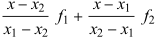
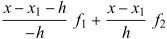
and the Lagrange interpolating polynomial through the points  and
and  is
is
 |  |  |
(2)
|
 |  |  |
(3)
|
 |  |  |
(4)
|
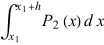
Integrating over the interval (i.e., finding the area of the trapezoid) then gives
 |  |  |
(5)
|
 |  | ![1/(2h)(f_2-f_1)[x^2]_(x_1)^(x_2)+(f_1+(x_1)/hf_1-(x_1)/hf_2)[x]_(x_1)^(x_2)](/images/equations/Newton-CotesFormulas/Inline34.svg) |
(6)
|
 |  |  |
(7)
|
 |  |  |
(8)
|
 |  |  |
(9)
|
 |  |  |
(10)
|
This is the trapezoidal rule (Ueberhuber 1997, p. 100), with the final term giving the amount of error (which, since  , is no worse than the maximum value of
  in this range).
The 3-point rule is known as Simpson's rule. The abscissas are
 |  |  |
(11)
|
 |  |  |
(12)
|
and the Lagrange interpolating polynomial is
 |  |  |
(13)
|
 |  |  |
(14)
|
 |  | ![1/(h^2){x^2(1/2f_1-f_2+1/2f_3)+x[-1/2(2x_1+3h)f_1+(2x_1+2h)f_2-1/2(2x_1+h)f_3]+[1/2(x_1+h)(x_1+2h)f_1-x_1(x_1+2h)f_2+1/2x_1(x_1+h)f_3]}.](/images/equations/Newton-CotesFormulas/Inline63.svg) |
(15)
|
Integrating and simplifying gives
 |
(16)
|
(Ueberhuber 1997, p. 100).
The 4-point closed rule is Simpson's 3/8 rule,
 |
(17)
|
(Ueberhuber 1997, p. 100). The 5-point closed rule is Boole's rule,
 |
(18)
|
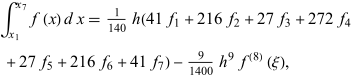
(Abramowitz and Stegun 1972, p. 886). Higher order rules include the 6-point
 |
(19)
|
7-point
 |
(20)
|
8-point
 |
(21)
|
9-point
 |
(22)
|
(Ueberhuber 1997, p. 100), 10-point
![int_(x_1)^(x_(10))f(x)dx=9/(89600)h[2857(f_1+f_(10))+15741(f_2+f_9)+1080(f_3+f_8)+19344(f_4+f_7)+5778(f_5+f_6)]-(173)/(14620)h^(11)f^((10))(xi),](/images/equations/Newton-CotesFormulas/NumberedEquation8.svg) |
(23)
|
and 11-point
![int_(x_1)^(x_(11))f(x)dx=5/(299376)h[16067(f_1+f_(11))+106300(f_2+f_(10))-48525(f_3+f_9)+272400(f_4+f_8)-260550(f_5+f_7)+427368f_6]-(1346350)/(326918592)h^(13)f^((12))(xi)](/images/equations/Newton-CotesFormulas/NumberedEquation9.svg) |
(24)
|
rules.
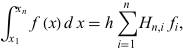
In general, the  -point
rule is given by the analytic expression
-point
rule is given by the analytic expression
 |
(25)
|
where
 |
(26)
|
(Whittaker and Robinson 1967, p. 154). This gives the triangle of coefficients shown in the following table (OEIS A093735 and A093736).
 | 0 | 1 | 2 | 3 | 4 | 5 |
| 1 |  |  | ||||
| 2 |  |  |  | |||
| 3 |  |  |  |  | ||
| 4 |  |  |  |  |  | |
| 5 |  |  |  |  |  |  |
Note that
 |
(27)
|
Closed "extended" rules use multiple copies of lower order closed rules to build up higher order rules. By appropriately tailoring this process, rules with
particularly nice properties can be constructed. For  tabulated points, using the trapezoidal
rule
tabulated points, using the trapezoidal
rule  times and adding the results gives
![int_(x_1)^(x_n)f(x)dx=(int_(x_1)^(x_2)+int_(x_2)^(x_3)+...+int_(x_(n-1))^(x_n))f(x)dx
=1/2h[(f_1+f_2)+(f_2+f_3)+...+(f_(n-2)+f_(n-1))+(f_(n-1)+f_n)]
=h(1/2f_1+f_2+f_3+...+f_(n-2)+f_(n-1)+1/2f_n)-1/(12)nh^3f^('')(xi)](/images/equations/Newton-CotesFormulas/NumberedEquation13.svg) |
(28)
|
(Ueberhuber 1997, p. 107). Using a series of refinements on the extended trapezoidal rule gives the method known as Romberg
integration. A 3-point extended rule for odd  is
is
![int_(x_1)^(x_n)f(x)dx=h[(1/3f_1+4/3f_2+1/3f_3)+(1/3f_3+4/3f_4+1/3f_5)+...+(1/3f_(n-4)+4/3f_(n-3)+1/3f_(n-2))+(1/3f_(n-2)+4/3f_(n-1)+1/3f_n)]
=1/3h(f_1+4f_2+2f_3+4f_4+2f_5+...+4f_(n-1)+f_n)-(n-1)/21/(90)h^5f^((4))(xi).](/images/equations/Newton-CotesFormulas/NumberedEquation14.svg) |
(29)
|
Applying Simpson's 3/8 rule, then Simpson's rule (3-point) twice, and adding gives
![[int_(x_1)^(x_4)+int_(x_4)^(x_6)+int_(x_6)^(x_8)]f(x)dx
=h[(3/8f_1+9/8f_2+9/8f_3+3/8f_4)+(1/3f_4+4/3f_5+1/3f_6)+(1/3f_6+4/3f_7+1/3f_8)]
=h[3/8f_1+9/8f_2+9/8f_3+(3/8+1/3)f_4+4/3f_5+(1/3+1/3)f_6+4/3f_7+1/3f_8]
=h(3/8f_1+9/8f_2+9/8f_3+(17)/(24)f_4+4/3f_5+2/3f_6+4/3f_7+1/3f_8).](/images/equations/Newton-CotesFormulas/NumberedEquation15.svg) |
(30)
|
Taking the next Simpson's 3/8 step then gives
 |
(31)
|
Combining with the previous result gives
![int_(x_1)^(x_(11))f(x)dx=h[3/8f_1+9/8f_2+9/8f_3+(17)/(24)f_4+4/3f_5+2/3f_6+4/3f_7+(1/3+3/8)f_8+9/8f_9+9/8f_(10)+3/8f_(11)]
=h(3/8f_1+9/8f_2+9/8f_3+(17)/(24)f_4+4/3f_5+2/3f_6+4/3f_7+(17)/(24)f_8+9/8f_9+9/8f_(10)+3/8f_(11)),](/images/equations/Newton-CotesFormulas/NumberedEquation17.svg) |
(32)
|
where terms up to  have now been completely determined. Continuing gives
 |
(33)
|
Now average with the 3-point result
 |
(34)
|
to obtain
![h[(17)/(48)f_1+(59)/(48)f_2+(43)/(48)f_3+(49)/(48)f_4+(f_5+f_6+...+f_(n-5)+f_(n-4))+(49)/(48)f_(n-3)+(43)/(48)f_(n-2)+(59)/(48)f_(n-1)+(17)/(48)f_n]+O(n^(-4)).](/images/equations/Newton-CotesFormulas/NumberedEquation20.svg) |
(35)
|
Note that all the middle terms now have unity coefficients. Similarly, combining a 3-point with the (2+3)-point rule gives
 |
(36)
|
Other Newton-Cotes rules occasionally encountered include Durand's rule
 |
(37)
|
(Beyer 1987), Hardy's rule
![int_(x_0-3h)^(x_0+3h)f(x)dx=1/(100)h(28f_(-3)+162f_(-2)+22f_0+162f_2+28f_3)
+9/(1400)h^7[2f^((4))(xi_2)-h^2f^((8))(xi_1)],](/images/equations/Newton-CotesFormulas/NumberedEquation23.svg) |
(38)
|
and Weddle's rule
 |
(39)
|
(Beyer 1987).
The open Newton-Cotes rules use points outside the integration interval, yielding the 1-point
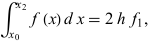 |
(40)
|
2-point
 |  | 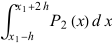 |
(41)
|
 |  | ![1/(2h)(f_2-f_1)[x^2]_(x_1-h)^(x_1+2h)+(f_1+(x_1)/hf_1-(x_1)/hf_2)[x]_(x_1-h)^(x_1+2h)](/images/equations/Newton-CotesFormulas/Inline95.svg) |
(42)
|
 |  |  |
(43)
|
3-point
 |
(44)
|
4-point
 |
(45)
|
5-point
 |
(46)
|
6-point
 |
(47)
|
and 7-point
 |
(48)
|
rules.
A 2-point open extended formula is
![int_(x_1)^(x_n)f(x)dx=h[(1/2f_1+f_2+...+f_(n-1)+1/2f_n)+1/(24)(-f_0+f_2+f_(n-1)-f_(n+1))]+(11(n+1))/(720)h^5f^((4))(xi).](/images/equations/Newton-CotesFormulas/NumberedEquation31.svg) |
(49)
|
Single interval extrapolative rules estimate the integral in an interval based on the points around it. An example of such a rule is
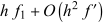 |
(50)
|
 |
(51)
|
 |
(52)
|
 |
(53)
|
