

A continuous function may be defined in several commonly used ways (and, depending on context, is also called a continuous map). The space of continuous functions is
denoted  ,
and corresponds to the
,
and corresponds to the  case of a Ck
function.
case of a Ck
function.
A continuous function can be formally defined as a function  where the pre-image of every
open set in
where the pre-image of every
open set in  is open in
  . More concretely, a function
  in a single variable
  is said to be continuous at point
  if
if
1.  is defined, so that
  is in the domain of
  .
.
2.  exists for
  in the domain of
  .
.
3.  ,
,
where lim denotes a limit.
Many mathematicians prefer to define the continuity of a function via a so-called epsilon-delta definition of a limit.
In this formalism, a limit  of function
  as
as  approaches a point
  ,
,
 |
(1)
|
is defined when, given any  , a
, a  can be found such that for every
  in some domain
  and within the neighborhood of
  of radius
  (except possibly
  itself),
 |
(2)
|
Then if  is in
is in  and
and
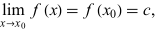 |
(3)
|
 is said to be continuous at
  .
.
If  is differentiable at point
  , then it is also continuous at
  . If two functions
  and
and  are continuous at
  , then
1.  is continuous at
  .
.
2.  is continuous at
  .
.
3.  is continuous at
  .
.
4.  is continuous at
  if
if  .
.
5. Providing that  is continuous at
  ,
,
 is continuous at
  ,
where
,
where  denotes
  ,
the function composition of the functions
,
the function composition of the functions
 and
and  .
.

The notion of continuity for a function in two variables is slightly trickier, as illustrated above by the plot of the function
 |
(4)
|
This function is discontinuous at the origin, but has limit 0 along the line  , limit 1 along the x-axis,
and limit
, limit 1 along the x-axis,
and limit  along the y-axis (Kaplan 1992, p. 83).
