


Von Neumann's elephant is a recreational problem of describing an elephant-shaped plane curve using only four parameters. The problem grew out of a remark attributed to John von Neumann by Enrico Fermi, as recalled by Dyson (2004), "With four parameters I can fit an elephant, and with five I can make him wiggle his trunk." Fermi used the remark in a 1953 discussion with Dyson to question whether agreement with data obtained by adjusting several arbitrary parameters was sufficient evidence for a physical model (Dyson 2004).
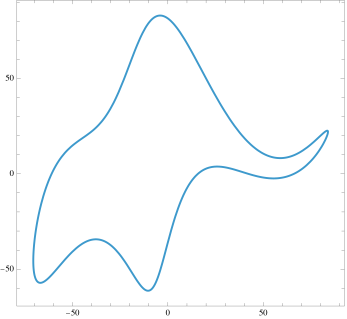
Mayer et al. (2010) constructed a schematic elephant using truncated Fourier series. Interchanging the coordinate labels in their coefficient table gives the parametric equations
 |  |  |
(1)
|
 |  |  |
(2)
|
where  .
Their four complex parameters are
.
Their four complex parameters are  ,
,  ,
,  , and
, and  . The real part and imaginary
part of each supply two of the eight nonzero Fourier
coefficients in these equations. The choice of which Fourier
coefficients vanish is part of the prescribed model. Thus the construction uses
four complex numbers, equivalent to eight real
parameters, rather than four real parameters.
A fifth complex number specifies the additional
trunk-motion control and the eye in the authors' construction (Mayer et al. 2010).
. The real part and imaginary
part of each supply two of the eight nonzero Fourier
coefficients in these equations. The choice of which Fourier
coefficients vanish is part of the prescribed model. Thus the construction uses
four complex numbers, equivalent to eight real
parameters, rather than four real parameters.
A fifth complex number specifies the additional
trunk-motion control and the eye in the authors' construction (Mayer et al. 2010).
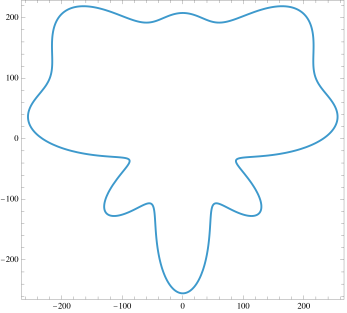
Jin and Yuan (2024) give a frontal view using a polar curve with four nonconstant Fourier coefficients. In a convenient orientation, their curve can be written
 |
(3)
|
The elephant appears when  is drawn in polar coordinates,
rather than plotted as an ordinary graph of
is drawn in polar coordinates,
rather than plotted as an ordinary graph of  against
  . The offset
  is about 200 in the authors' pixel scale. Changing it shifts
all radial distances and therefore changes the proportions of the curve, although
modest changes leave the elephant shape recognizable. The resulting curve traces
a stylized frontal view with two ears, two tusks, and a trunk. The four harmonic
indices, the zero coefficients, and the choice of a symmetric frontal view are also
fixed in advance. The authors therefore describe their result as satisfying a weaker
requirement of four nonzero coefficients, rather than an unrestricted four-parameter
description.
is about 200 in the authors' pixel scale. Changing it shifts
all radial distances and therefore changes the proportions of the curve, although
modest changes leave the elephant shape recognizable. The resulting curve traces
a stylized frontal view with two ears, two tusks, and a trunk. The four harmonic
indices, the zero coefficients, and the choice of a symmetric frontal view are also
fixed in advance. The authors therefore describe their result as satisfying a weaker
requirement of four nonzero coefficients, rather than an unrestricted four-parameter
description.
These constructions illustrate why a parameter count must specify what is allowed to vary and what is built into the representation. Piantadosi
(2018) gives a related construction based on the logistic
map in which one real parameter can fit arbitrarily
many data values in  at distinct nonnegative integer
arguments to any fixed positive accuracy. The information is encoded in the digits
of that parameter, so counting parameters
alone does not measure the complexity of a model or its predictive value.
at distinct nonnegative integer
arguments to any fixed positive accuracy. The information is encoded in the digits
of that parameter, so counting parameters
alone does not measure the complexity of a model or its predictive value.
