For this value, the equation has 45 real roots, given by
for ,
1, ..., 44. Of these roots, 23 are positive
and 22 are negative. François Viète found
all 23 positive solutions; the smallest is (Viète 1595, van Assche 2022).
Stillwell, J. Mathematics and Its History, 3rd ed. New York: Springer-Verlag, p. 108, 2010. https://doi.org/10.1007/978-1-4419-6053-5.Van
Assche, W. "Chebyshev Polynomials in the 16th Century." J. Approx. Theory279,
105767, 2022. https://doi.org/10.1016/j.jat.2022.105767.van
Roomen, A. Ideae Mathematicae Pars Prima, Sive Methodus Polygonorum. Antwerp,
Belgium: Ioannem Keerbergium, 1593. https://books.google.com/books?id=nMUfMvJNYl4C.Viète,
F. Ad problema quod omnibus mathematicis totius orbis construendum proposuit Adrianus
Romanus. Paris, France: Jamet Mettayer, 1595. Reprinted in Opera Mathematica
(Ed. F. van Schooten). Leiden, Netherlands, pp. 305-323, 1646.



 is a Chebyshev polynomial of the
first kind. Under the substitution
is a Chebyshev polynomial of the
first kind. Under the substitution  , it satisfies the multiple-angle
formula
, it satisfies the multiple-angle
formula  .
.




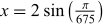 has 45 real roots, given by
 for
for  ,
1, ..., 44. Of these roots, 23 are positive
and 22 are negative. François Viète found
all 23 positive solutions; the smallest is
,
1, ..., 44. Of these roots, 23 are positive
and 22 are negative. François Viète found
all 23 positive solutions; the smallest is 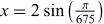 (Viète 1595, van Assche 2022).
