TOPICS
Search

q-Pi


q-Pi

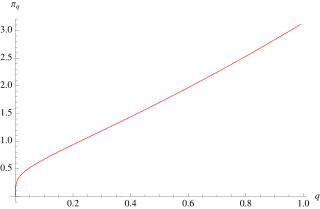
q-pi, denoted pi_q, is a q-analog of pi. For 0<q<1, it can be defined using the q-factorial

 [a]_q!=1(1+q)(1+q+q^2)...(1+q+...+q^(a-1))
(1)

for a nonnegative integer a, extended to other arguments by [a]_q!=Gamma_q(a+1), where Gamma_q is the q-gamma function. Gosper's normalization gives

 1=sin_q^*(1/2pi)=(pi_q)/(([-1/2]_(q^2)!)^2q^(1/4)),
(2)

where sin_q^*z is Gosper's q-sine, so

pi_q=q^(1/4)([-1/2]_(q^2)!)^2
(3)
=1/2(1-q^2)theta_2(0,q)theta_3(0,q)
(4)
=1/4(1-q^2)theta_2^2(0,sqrt(q))
(5)
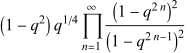
=(1-q^2)q^(1/4)product_(n=1)^(infty)((1-q^(2n))^2)/((1-q^(2n-1))^2)
(6)

(Gosper 2001), where theta_j(z,q) is a Jacobi theta function.

It has the expansion about q=0

 pi_q=q^(1/4)(1+2q+q^4-2q^5+q^6+2q^7-3q^8+2q^(10)-q^(12)+...)
(7)

(OEIS A144874).

It is related to the q-analog of the Wallis formula (Gosper 2001), and has the special value

 lim_(q->1^-)pi_q=pi.
(8)

The area under pi_q is given by

 int_0^1pi_qdq=1.7249911260345...
(9)

(OEIS A144875).

Gosper (2001) developed an iterative algorithm for computing pi_q based on the algebraic recurrence relation

 (4pi_(q^4))/(q^4+1)=((q^2+1)^2pi_q^2)/(pi_(q^2))-((q^4+1)pi_(q^2)^2)/(pi_(q^4)).
(10)

See also

Pi, q-Analog, q-Cosine, q-Exponential Function, q-Factorial, q-Sine, Wallis Formula

Explore with Wolfram|Alpha

WolframAlpha

More things to try:

References

Gosper, R. W. "Experiments and Discoveries in q-Trigonometry." In Symbolic Computation, Number Theory, Special Functions, Physics and Combinatorics. Proceedings of the Conference Held at the University of Florida, Gainesville, FL, November 11-13, 1999 (Ed. F. G. Garvan and M. E. H. Ismail). Dordrecht, Netherlands: Kluwer, pp. 79-105, 2001. https://doi.org/10.1007/978-1-4613-0257-5_6.Sloane, N. J. A. Sequences A144874 and A144875 in "The On-Line Encyclopedia of Integer Sequences."

Referenced on Wolfram|Alpha

q-Pi

Cite this as:

Weisstein, Eric W. "q-Pi." From MathWorld--A Wolfram Resource. https://mathworld.wolfram.com/q-Pi.html

Subject classifications