

The  -invariant is an invariant of an elliptic
curve under isomorphism over an algebraic
closure. For a general Weierstrass equation
-invariant is an invariant of an elliptic
curve under isomorphism over an algebraic
closure. For a general Weierstrass equation
 |
(1)
|
define
 |  |  |
(2)
|
 |  |  |
(3)
|
 |  |  |
(4)
|
 |  |  |
(5)
|
The standard invariants of the equation are
 |  |  |
(6)
|
 |  |  |
(7)
|
Here,  is the weight-four invariant and
  is the elliptic discriminant.
For
is the elliptic discriminant.
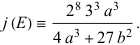
For  , the
, the  -invariant is
 |
(8)
|
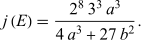
Over a field whose field characteristic is different from 2 and 3, an elliptic
curve can be written in short Weierstrass form  , in which case
 |
(9)
|
Two elliptic curves over an algebraically closed field are isomorphic if and only if they
have the same  -invariant.
Over a non-algebraically closed base field, curves
with the same
-invariant.
Over a non-algebraically closed base field, curves
with the same  -invariant
need not be isomorphic. Such curves may be twists
of one another. Over a field whose field characteristic
is different from 2 and 3, the exceptional values
-invariant
need not be isomorphic. Such curves may be twists
of one another. Over a field whose field characteristic
is different from 2 and 3, the exceptional values  and
and  correspond to curves having additional automorphisms.
Over  ,
an elliptic curve is analytically isomorphic to
a complex torus
,
an elliptic curve is analytically isomorphic to
a complex torus  for
for  in the upper half-plane,
and its
in the upper half-plane,
and its  -invariant
is the value
-invariant
is the value  of the modular j-function. The Fourier
expansion and special values of
of the modular j-function. The Fourier
expansion and special values of  , together with its role in the theory of complex
multiplication, provide further arithmetic information about the
, together with its role in the theory of complex
multiplication, provide further arithmetic information about the  -invariant.

 -Invariant."
§7.2 in
-Invariant."
§7.2 in