

The de Casteljau algorithm evaluates a polynomial in Bernstein form by repeatedly interpolating between adjacent coefficients. Given
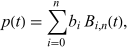 |
(1)
|
where  is a Bernstein polynomial, set
 and compute
 |
(2)
|
for  , ...,
 and
 , ...,
 . Then
 |
(3)
|
Expanding the recursion gives the Bernstein weights 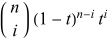 .
With vector control points in place of scalar coefficients, the construction evaluates a Bézier curve.
At a fixed parameter  , the first point of
each successive level, in level order, gives the control points of the portion from
0 to
 . The last point of each level, in reverse level order,
gives the control points of the portion from
 to 1. Each portion is parametrized over
 using its new control points (Farin 1993).
