


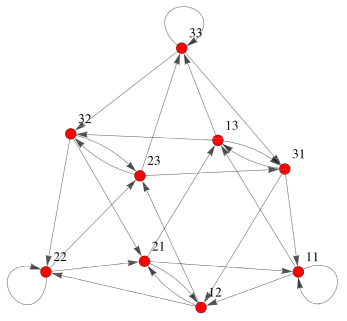
The  -de
Bruijn graph, for integers
 and
 , is the directed graph
whose vertices are the words of length
 over an alphabet of
 symbols. There is a directed
edge from one word to another when deleting the first symbol and appending one
symbol gives the second word. The graph has self-loops.
For example, the
 -de
Bruijn graph is illustrated above.
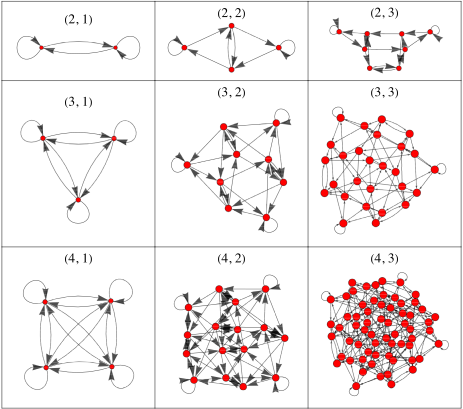
The above figures show the first few  -dimensional de Bruijn graphs on an alphabet
of
 symbols for
 .
The  -de
Bruijn graph is implemented in the Wolfram
Language as DeBruijnGraph[m,
n].
The Fritsch graph is the underlying simple graph of the  -de
Bruijn graph, obtained by forgetting edge directions and removing self-loops.
de Bruijn graphs are Eulerian and Hamiltonian. The  -de
Bruijn graph has vertex count
 , edge count
 ,
 self-loops, directed graph
diameter
 ,
and indegree and outdegree
 at every graph
vertex.
The independence numbers of the underlying simple graphs of the  -de Bruijn graphs for
 , 2, ... are 1, 2, 3, 7, 13, 28, ... (OEIS A006946).
For  ,
the
 -Kautz graph is obtained from the
 -de Bruijn graph by removing the vertices
whose words contain two consecutive identical symbols (Bermond et al. 1986).
