


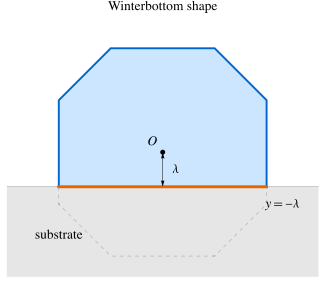
A Winterbottom shape is a truncation of a Wulff shape by a half-space, followed by translation and dilation, that minimizes anisotropic surface energy with a flat substrate contact term at prescribed volume (Winterbottom 1967, Kreutz and Schmidt 2026). It is the geometric solution of the corresponding constrained problem in the calculus of variations.
Let  be a positive continuous function on the unit sphere whose positively
homogeneous extension is convex, and let
 be the difference between the crystal-substrate
and substrate-vapor energies per unit area. For a region
 above the substrate
 , the energy is
 |
where  is the outward unit normal vector and
 denotes
 -dimensional area. The integrals
are interpreted measure-theoretically for sets
of finite perimeter.
Writing  for the vertical unit vector, the partial-wetting
range is
 . In this range the
minimizing shape is
 |
up to translation parallel to the substrate and sets of zero volume, where the positive scale factor  fixes the prescribed volume (Kreutz
and Schmidt 2026). The translation by
 places the cut on the substrate. The figure above
illustrates the cut for
 before this translation.
When  is constant, the Wulff shape is a closed
ball and the Winterbottom shape is a spherical cap
in three dimensions. The contact angle
 , measured through the drop,
satisfies
 . Thus
 gives a hemisphere,
while negative
 gives a flatter cap.
