

A finite perimeter set is a Lebesgue measurable set  whose perimeter
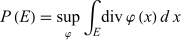 |
is finite. The supremum is over continuously differentiable vector fields  with compact
support and
 for every
 ,
where the norm is Euclidean and
 denotes divergence. The set
need not have finite Lebesgue measure (Maggi
2012).
Changing  on a set of Lebesgue measure zero leaves
 unchanged. For a bounded open
set with smooth boundary,
 equals the
 -dimensional Hausdorff
measure of that boundary, recovering the usual boundary surface area.
On a Riemannian manifold, the analogous definition
uses tangent vector fields, the metric norm
and divergence, and Riemannian volume.
This notion permits the isoperimetric inequality
to be formulated without requiring a smooth boundary.
