

The Weil conjectures are statements proposed by Weil (1949) about the zeta functions of projective smooth varieties over finite fields. They relate the numbers of rational points over extension fields to the Betti numbers of corresponding algebraic varieties over the complex numbers, and include an analog of the Riemann hypothesis.
Let  be a projective smooth variety of dimension
 over the finite
field
 , and let
 be the number of rational
points of
 over the extension field
 . Its zeta function
is defined by
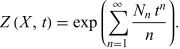 |
The conjectures assert that this is a rational function with a factorization
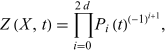 |
where the  are polynomials with integer coefficients and
 . The Riemann
hypothesis analog states that each reciprocal
of a polynomial root of
 is an algebraic integer
with complex modulus
 . There is also a functional
equation relating
 to
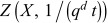 . If
 arises by nonsingular reduction of a projective smooth
variety defined over a number field, the polynomial
degree of
 equals the
 th
Betti number of the corresponding algebraic
variety over the complex numbers (Weil 1949).
Deligne (1974) completed the proof in 1973 by establishing the Riemann hypothesis analog. His published proof follows lectures given in July 1973 and builds on earlier results of Dwork and Grothendieck. This work earned Deligne the Fields medal (Derbyshire 2004, p. 270).
