

The Wald test is a large-sample statistical test of restrictions on an unknown parameter using the distance between an unrestricted
estimator and the value specified by the null
hypothesis. For a scalar parameter  , the Wald statistic for testing
  is
is
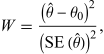 |
where  is the estimated standard
error of
is the estimated standard
error of  .
.
Under standard regularity conditions and the null hypothesis,  converges in distribution to a chi-squared
distribution with one degree of freedom. More generally, a joint Wald test of
converges in distribution to a chi-squared
distribution with one degree of freedom. More generally, a joint Wald test of
 independent smooth restrictions has an
asymptotic chi-squared distribution with
independent smooth restrictions has an
asymptotic chi-squared distribution with
 degrees of freedom.
