

The Volterra integral, also called the Volterra product integral, uses products in place of sums in the construction of an ordinary definite
integral. For a continuous function ![f:[a,b]->R](/images/equations/VolterraIntegral/Inline1.svg) and a division
and a division  , select a point
  in each interval
 ![[t_(j-1),t_j]](/images/equations/VolterraIntegral/Inline4.svg) . The integral is defined
by
. The integral is defined
by
![product_a^b[1+f(t)dt]=lim_(max_(j)Deltat_j->0)product_(j=1)^n[1+f(xi_j)Deltat_j]=exp(int_a^bf(t)dt),](/images/equations/VolterraIntegral/NumberedEquation1.svg) |
where ![xi_j in [t_(j-1),t_j]](/images/equations/VolterraIntegral/Inline5.svg) and
and 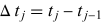 .
For a matrix-valued or operator-valued
function
.
For a matrix-valued or operator-valued
function  , 1 is replaced by the identity
matrix or identity operator, and the order
of the factors must be preserved. Taking later factors on the left gives the solution
, 1 is replaced by the identity
matrix or identity operator, and the order
of the factors must be preserved. Taking later factors on the left gives the solution
 of
of  with
with  ; reversing the order gives the analogous right-acting
equation. The Volterra integral is distinct from the Volterra
integral equation of the first kind and Volterra
integral equation of the second kind, in which a variable
occurs as a limit of an ordinary definite
integral.
; reversing the order gives the analogous right-acting
equation. The Volterra integral is distinct from the Volterra
integral equation of the first kind and Volterra
integral equation of the second kind, in which a variable
occurs as a limit of an ordinary definite
integral.
