

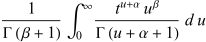
The Volterra functions  and
 are defined for
 , real
 , and real
 by the integrals (Erdélyi
et al. 1955, pp. 217-218)
 |  |  |
(1)
|
 |  |  |
(2)
|
where  is the gamma function and reciprocals of
 are taken to vanish at its poles.
In particular,
 .
For  and real
 , the Laplace
transform with respect to
 is (Garrappa and Mainardi 2016)
 |
(3)
|
The transform follows by interchanging the integrals and evaluating the inner integral in  with the gamma function.
In particular, the Laplace transform of
 is
 . These functions arise in solving Volterra
integral equations of the first kind with a logarithmic integral
kernel (Garrappa and Mainardi 2016).
The special case  can be written as the difference between the exponential
function and an integral due to Ramanujan (Garrappa
and Mainardi 2016),
 |
(4)
|
The Volterra functions will be implemented in a future version of the Wolfram Language as VolterraMu[beta, alpha, t] for  and VolterraNu[alpha,
t] for
 . The shorter forms VolterraMu[beta,
t] and VolterraNu[t] set
 .
