


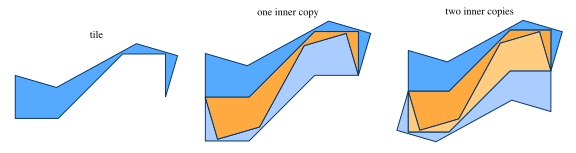
The Voderberg tile is a nonconvex nonagon whose copies can enclose one or two other copies without overlap. It is named for Heinz Voderberg (1936), who introduced it. The illustration uses the construction described by Trott (2004, sec. 1.1.4).
Two congruent copies can be arranged so that the complement set of their union in the plane has a bounded connected component. Its topological closure is filled by one or two further congruent copies whose interiors form disjoint sets. The inner copies retain boundary points on the exterior boundary of the whole arrangement, so enclosure here does not mean complete surrounding (Adams et al. 2020).
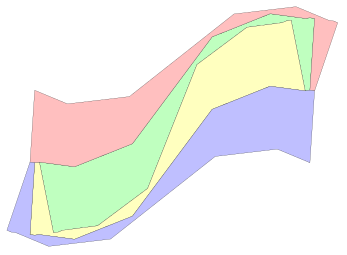
Trump (2020) constructed modified Voderberg tiles with 20 sides for which two congruent copies completely surround two others without overlap, as illustrated above. The union of the inner two lies entirely in the interior of the union of all four. He also exhibits a 16-sided variant.
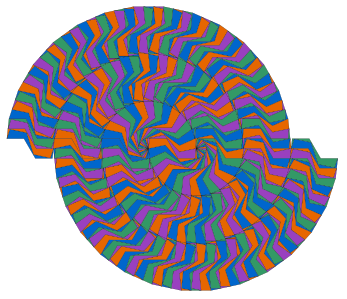
Suitable choices of the tile's shape admit both periodic and spiral monohedral tilings of the plane (Voderberg 1937, Adams et al.
2020). The spiral illustration in Voderberg (1936) contains an error corrected
by Voderberg (1937). The illustrated patch uses a tip angle
of  and a large convex angle
of
 . Waldman (2014, pp. 19-22)
constructs 30 radial sectors and shifts one half by one base interval to obtain the
spiral arrangement. This choice is a different member of the Voderberg tile family
from the enclosure example above.
