


A monohedral tiling is a tiling in which all tiles are congruent.
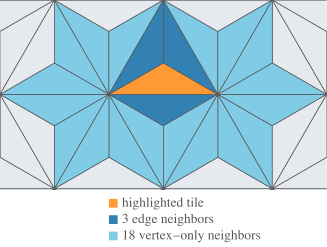
Yang and Wang (2026) report that a tiling of the plane by congruent compact convex tiles, with reflections
allowed, has common neighbor number at most 21. Here every tile must have the same
number of neighbors, and any nonempty intersection counts, including a point contact.
No periodicity or side-to-side assumption is imposed. Equality holds iff
the prototile is a triangle with angles  ,
 , and
 and the tiling is similar to the central subdivision of the triangular
grid. Joining the center of every equilateral
triangle to its three vertices gives this subdivision.
Each resulting tile has three neighbors sharing a line
segment and 18 meeting it only at a vertex.

 -Anisohedral Tile for
 ?" Amer. Math. Monthly 100, 585-588,
1993.Grünbaum, B. and Shephard, G. C. "The 81 Types of
Isohedral Tilings of the Plane." Math. Proc. Cambridge Philos. Soc. 82,
177-196, 1977.Yang, Y. and Wang, E. "Convex Monohedral Tilings:
a Sharp Neighbor Bound and Rigidity in the Equality Case." 10 Nov 2026.