TOPICS
Search

Umemura's Formula


Umemura's formula expresses the roots of an algebraic equation in terms of theta constants whose period matrix is obtained from Abelian integrals on a hyperelliptic curve (Umemura 1984).

Let f(x) be an irreducible polynomial of polynomial degree n>=2 over a subfield of C. Form the hyperelliptic curve y^2=F(x), where

 F(x)={x(x-1)f(x)   if n is odd; x(x-1)(x-2)f(x)   if n is even.
(1)

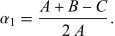
Its genus is g=|_(n+2)/2_|, where |_x_| denotes the floor function. Let alpha_1, ..., alpha_n be the roots of f(x). Order the finite branch points as 0, 1, alpha_1, ..., alpha_n, followed by 2 when n is even, and choose a compatible basis of homology for the normalized period matrix Omega. Put u=(1/2,0,...,0) and v=(0,1/2,0,...,0), and write T(a,b)=theta_(a,b)(0|Omega)^4 for the fourth power of a theta constant. Put A=T(u,0)T(u+v,0), B=T(0,0)T(v,0), and C=T(0,u)T(v,u). Then

 alpha_1=(A+B-C)/(2A).
(2)

The characteristics in this expression must be used with the compatible ordering and period basis. Changing the ordering gives the other roots (Umemura 1984; Shokurov 1998, p. 231). The expression uses Abelian integrals and theta constants, so it is not a solution by radicals.


See also

Abelian Integral, Algebraic Equation, Polynomial Roots, Riemann Theta Function, Theta Constant

Explore with Wolfram|Alpha

References

Shokurov, V. V. "Algebraic Curves and Their Jacobians." In Algebraic Geometry III: Complex Algebraic Varieties, Algebraic Curves and Their Jacobians. (Ed. A. N. Parshin and I. R. Shafarevich). Berlin, Germany: Springer, pp. 219-261, 1998. https://doi.org/10.1007/978-3-662-03662-4_2.Umemura, H. "Resolution of Algebraic Equations by Theta Constants." Part C in Tata Lectures on Theta. II. Jacobian Theta Functions and Differential Equations. by D. Mumford. Boston, MA: Birkhäuser, pp. 261-270, 1984.

Cite this as:

Weisstein, Eric W. "Umemura's Formula." From MathWorld--A Wolfram Resource. https://mathworld.wolfram.com/UmemurasFormula.html

Subject classifications