


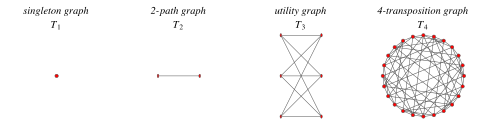
The transposition graph  considered here is the Cayley
graph of the symmetric group
considered here is the Cayley
graph of the symmetric group  generated by all transpositions.
Equivalently, its vertices are the
generated by all transpositions.
Equivalently, its vertices are the  permutations, with two vertices
adjacent when the corresponding permutations differ by exactly
one transposition (Skiena 1990, pp. 1-2
and 9-10; Pemmaraju and Skiena 2003, pp. 64-65 and 96; Clark 2005).
permutations, with two vertices
adjacent when the corresponding permutations differ by exactly
one transposition (Skiena 1990, pp. 1-2
and 9-10; Pemmaraju and Skiena 2003, pp. 64-65 and 96; Clark 2005).
More generally, for a set  of transpositions, the transposition generating graph has vertex set
  and an edge
  iff
iff  . The associated Cayley
graph
. The associated Cayley
graph  is called a complete transposition graph when its transposition
generating graph is the complete graph
is called a complete transposition graph when its transposition
generating graph is the complete graph  , equivalently when
  contains all
  transpositions (Ganesan
2015, Yang 2018). Thus, "complete" describes the generating graph, not
the Cayley graph itself. Transposition graphs that
are not complete in this sense use a proper subset
transpositions (Ganesan
2015, Yang 2018). Thus, "complete" describes the generating graph, not
the Cayley graph itself. Transposition graphs that
are not complete in this sense use a proper subset  and join two permutations
only when they differ by one of the transpositions
in
and join two permutations
only when they differ by one of the transpositions
in  .
For the graph generated by all transpositions discussed
here, the qualifier "complete" is commonly omitted (Skiena 1990, pp. 1-2
and 9-10; Pemmaraju and Skiena 2003, pp. 64-65 and 96; Clark 2005). The notations
.
For the graph generated by all transpositions discussed
here, the qualifier "complete" is commonly omitted (Skiena 1990, pp. 1-2
and 9-10; Pemmaraju and Skiena 2003, pp. 64-65 and 96; Clark 2005). The notations
 (Berestycki 2006, p. 429) and
  (Baggett and Yan 2026) are used for this Cayley
graph on
(Baggett and Yan 2026) are used for this Cayley
graph on  .
.
The transposition graph  has vertex count
  , edge count
  (for
(for  ), and is regular of degree
  (Clark 2005). All cycles in transposition graphs are
of even length, making them bipartite.
(Clark 2005). All cycles in transposition graphs are
of even length, making them bipartite.
The transposition graph of a multiset is always Hamiltonian (Chase 1973).
A strict Hamilton decomposition of  into Hamiltonian
cycles alone is possible only when its degree
into Hamiltonian
cycles alone is possible only when its degree  is even, or equivalently when
  (mod 4) or
  (mod 4). Under the extended convention allowing one perfect
matching when the degree is odd, Shi and Niu (2009) conjectured that every complete
transposition graph is a Hamilton decomposable
graph. Such a decomposition must contain
(mod 4). Under the extended convention allowing one perfect
matching when the degree is odd, Shi and Niu (2009) conjectured that every complete
transposition graph is a Hamilton decomposable
graph. Such a decomposition must contain  Hamiltonian cycles and, when
  (mod 4) or
  (mod 4), one perfect matching. Shi and Niu (2009) verified
the conjecture for
(mod 4), one perfect matching. Shi and Niu (2009) verified
the conjecture for  and 3, and direct certificates give decompositions also for
  and 5. The general conjecture remains open.
As partial progress, Hussak (2016) proved that  contains at least
  pairwise edge-disjoint Hamiltonian
cycles for every
pairwise edge-disjoint Hamiltonian
cycles for every  . A full Hamilton
decomposition or quasi-Hamilton decomposition
requires
. A full Hamilton
decomposition or quasi-Hamilton decomposition
requires  such cycles, so this result does not settle the conjecture of Shi and Niu. Baggett
and Yan (2026) subsequently proved that
such cycles, so this result does not settle the conjecture of Shi and Niu. Baggett
and Yan (2026) subsequently proved that  is paired 2-disjoint-path-coverable and therefore Hamilton-laceable.
However, this stronger Hamiltonian-path property
likewise does not provide an edge decomposition.
is paired 2-disjoint-path-coverable and therefore Hamilton-laceable.
However, this stronger Hamiltonian-path property
likewise does not provide an edge decomposition.
Special cases are summarized in the table below.



 -Trees." Disc. Appl. Math. 237, 132-138,
2018.
-Trees." Disc. Appl. Math. 237, 132-138,
2018.