

The total variation distance between probability measures  and
and  on the same measurable space is
  , where the supremum
is over measurable sets. It equals half the total
variation of the signed measure
, where the supremum
is over measurable sets. It equals half the total
variation of the signed measure  on the whole space.
For probability mass functions  and
and  on a countable set, it is
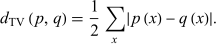 |
The distance lies between 0 and 1. It is zero precisely when the distributions agree and is 1 when they have disjoint supports. The trace distance of diagonal density matrices reduces to this classical distance.
