

The three squares in a rectangle problem asks for the maximum sum of the side lengths of three squares contained in a  rectangle, where
  and the interiors of the squares
are pairwise disjoint. The squares may have different
sizes and may undergo arbitrary rotation. Yang (2026)
determined the maximum to be
and the interiors of the squares
are pairwise disjoint. The squares may have different
sizes and may undergo arbitrary rotation. Yang (2026)
determined the maximum to be
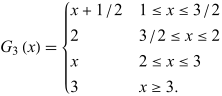 |
(1)
|
In particular, the maximum is 3/2 in a unit square and 2 in a  rectangle. The latter
value is attained by one unit square and two squares
of side length 1/2. For
rectangle. The latter
value is attained by one unit square and two squares
of side length 1/2. For  , three unit squares attain
the maximum 3. The upper bounds allow all orientations, even though these examples
have sides parallel to the boundary.
, three unit squares attain
the maximum 3. The upper bounds allow all orientations, even though these examples
have sides parallel to the boundary.
