


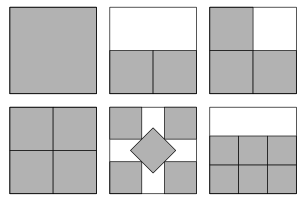
Square packing asks for the minimum size square capable of bounding  equal squares arranged in any configuration. The first
few cases are illustrated above (Friedman). Among the nontrivial cases, packings
which have been proven optimal include 2, 3, 5, 6, 7, 8, 10, 13, 14, 15, 22, 23,
24, 33, 34, and 35, in addition to the trivial cases of the square
numbers (Friedman and Ellsworth).
equal squares arranged in any configuration. The first
few cases are illustrated above (Friedman). Among the nontrivial cases, packings
which have been proven optimal include 2, 3, 5, 6, 7, 8, 10, 13, 14, 15, 22, 23,
24, 33, 34, and 35, in addition to the trivial cases of the square
numbers (Friedman and Ellsworth).
If  for some
  , it is conjectured that the
size of the minimum bounding square is
, it is conjectured that the
size of the minimum bounding square is  for small
  . The smallest
  for which the conjecture is
known to be violated is
for which the conjecture is
known to be violated is  (with
(with  ).
).
Let  be the least side length of a square containing
  unit squares with arbitrary orientations
and pairwise disjoint interiors. Nagamochi (2005) claimed
a rectangle bound implying
unit squares with arbitrary orientations
and pairwise disjoint interiors. Nagamochi (2005) claimed
a rectangle bound implying
 for every integer
  . Karakus (2026) constructed counterexamples to the scoring assertion used in
the proof, so the published proof
of the rectangle bound is incomplete, although the
bound itself is not disproved.
. Karakus (2026) constructed counterexamples to the scoring assertion used in
the proof, so the published proof
of the rectangle bound is incomplete, although the
bound itself is not disproved.
Karakus (2026) independently proved, for every integer  , the weaker result
 |
(1)
|
and, for every nonsquare integer  , the lower bound
 |
(2)
|
This argument does not establish  . Karakus (2026) reports using AI tools during exploratory
work, for symbolic and numerical checks, and for language and typesetting assistance,
and states that all mathematical arguments and calculations were independently checked.
. Karakus (2026) reports using AI tools during exploratory
work, for symbolic and numerical checks, and for language and typesetting assistance,
and states that all mathematical arguments and calculations were independently checked.
The following table gives the smallest known side lengths for a square into which  unit squares can be packed (Friedman
and Ellsworth). An asterisk (*) indicates that a packing has been proven to be optimal.
unit squares can be packed (Friedman
and Ellsworth). An asterisk (*) indicates that a packing has been proven to be optimal.
 | exact | approx. |  | exact | approx. |
| 1* | 1 | 1 | 16* | 4 | 4 |
| 2* | 2 | 2 | 17 | 4.6755... | |
| 3* | 2 | 2 | 18 |  | 4.822... |
| 4* | 2 | 2 | 19 |  | 4.885... |
| 5* |  | 2.707... | 20 | 5 | 5 |
| 6* | 3 | 3 | 21 | 5 | 5 |
| 7* | 3 | 3 | 22* | 5 | 5 |
| 8* | 3 | 3 | 23* | 5 | 5 |
| 9* | 3 | 3 | 24* | 5 | 5 |
| 10* |  | 3.707... | 25* | 5 | 5 |
| 11 | 3.877... | 26 |  | 5.6214... | |
| 12 | 4 | 4 | 27 |  | 5.7072... |
| 13* | 4 | 4 | 28 | 5.8244... | |
| 14* | 4 | 4 | 29 | 5.9338... | |
| 15* | 4 | 4 |
The value listed for  is the polynomial root
  (Ellsworth).
In December 2025, T. Schadt found a packing of 50 unit squares in a square of side length
 |
(3)
|
The construction, subsequently optimized by D. Ellsworth, uses orientations determined by a 3, 4, 5 triangle and is the smallest
known as of September 2026 for  (Ellsworth, Pegg 2026).
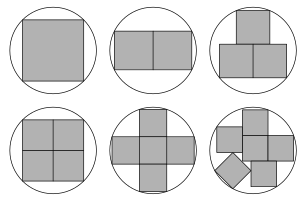
The best known packings of squares into a circle are illustrated above for the first few cases (Friedman).
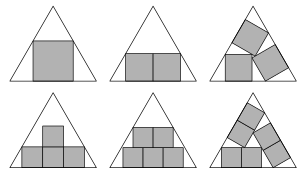
The best known packings of squares into an equilateral triangle are illustrated above for the first few cases (Friedman).

The best packing of a square inside a pentagon, illustrated above, is 1.0673....

 Pegg, E. Jr. Mathematical Games. Episode 45: "Filling Space with
Similar Parts." Sep. 24, 2026.
Pegg, E. Jr. Mathematical Games. Episode 45: "Filling Space with
Similar Parts." Sep. 24, 2026.