

The Thomas algorithm is a specialized form of Gaussian elimination for solving a tridiagonal matrix
system. For subdiagonal entries  , diagonal entries
  , superdiagonal entries
  , and right-hand side
  , set
, set  and
and  . For
. For  , ...,
  , forward elimination computes
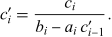 |
For  ,
...,
,
...,  ,
it computes
,
it computes
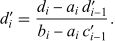 |
Back substitution starts with  and continues with
  for
for  , ..., 1.
The algorithm requires only linear time and storage in the number of equations. Pivoting or a more general solver may be needed when an elimination denominator vanishes or is too small for stable floating-point computation.
