

The systole of a closed Riemannian manifold with nontrivial fundamental group is the least length of a closed curve that is not homotopic to a constant curve (Katz 2007). It is also called the homotopy 1-systole. For a closed hyperbolic surface, it is the length of the shortest closed geodesic.
Let  denote the supremum
of the systoles of closed oriented hyperbolic surfaces
of genus
 , with Gaussian curvature
normalized to
 .
An area comparison gives
 |
(1)
|
Indeed, a hyperbolic disk of radius half the systole is embedded in the surface, and its
area cannot exceed  .
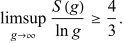
The arithmetic constructions of Buser and Sarnak (1994) give
 |
(2)
|
This statement concerns a sequence of genera and does not give the same lower bound for every sufficiently large genus. Cai (2026) reported the every-genus estimate
 |
(3)
|
for all sufficiently large  ,
implying a infimum limit of at least 1 for
 .
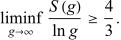
Gargava (2026) reported the stronger every-genus bound
 |
(4)
|
The construction combines arithmetic hyperbolic surfaces, representations by prime cubes, and geometric gluing followed by a conformal change
to Gaussian curvature  . It does not establish that
 has a limit.
Cai (2026) credits GPT-5.6 Sol with developing the proof within his geometric framework. Gargava (2026) reports human-directed AI assistance with the mathematical development and Lean formalization. As of Oct. 25, 2026, Gargava's statement and proof were public as a Lean development, but independent specialist review of the two new bounds had not been reported.
