


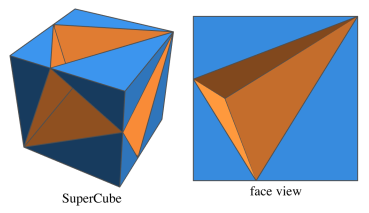
The supercube is a nonconvex polyhedron formed by removing six tetrahedral indentations from a cube, one in each face. Reiner (2026) reconstructed an earlier paper model by Einar Thorsteinn and derived its geometry from the first cube 5-compound.
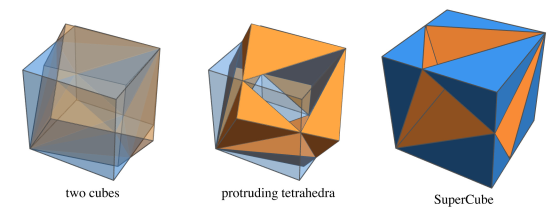
The construction above starts with a cube 2-compound formed by two cubes from that compound. The six tetrahedra protruding from one cube are reflected inward across the corresponding faces of the other and subtracted from it. For a cube centered at the origin with unit-length edges, the relative rotation of the second cube is given by
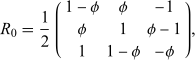 |
where  is the golden
ratio (Reiner 2026). The opening of each indentation is a triangle
that divides two edges of the original face
into lengths
 and
 .
Copies of the unit interlock through their tetrahedral indentations. Reiner (2026) constructs periodic arrays and bounded assemblies, including a 60-unit "SuperCubeSphere" whose rotations form the icosahedral group. These assemblies leave tetrahedral voids. In the periodic construction, additional complementary pieces fill the voids to produce a space-filling assembly (Reiner 2026).
