

The sum of square roots problem asks for the sign of the difference of two sums of square roots of positive integers. It arises when comparing path lengths in computational geometry, and it is open whether the sign can always be determined in time polynomial in the input size (Demaine et al. ).
Let  be the least positive value of
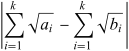 |
for  , with
 and
 .
A sufficiently strong lower bound on
 controls how many bits of precision suffice to distinguish
unequal sums. In particular, a bound on
 that is polynomial in
 and
 would give a polynomial-time sign algorithm (Demaine
et al. ).
Qian and Wang (2006) obtained  for fixed
 , where
 denotes big-O notation.
They also noted the sharper order
 for
 .
Besevic (2026a) reports
 for each fixed
 and a lower bound
 . The paper reports
Lean verification of explicit bounds for
 and
 .
The general upper bound uses a separate argument involving elliptic
curves. Besevic discloses AI assistance in the research and formalization.
Besevic (2026b, Theorems 3.3 and 4.2) reports  and
 for
 . For three terms per side, the first lower bound
is multiplied by
 when the two sums of radicands have the same parity.
The general estimate uses the second moment over signed sums and an integer product
of conjugate factors. For three terms per side with all radicands in an interval
of width
 , the paper gives a lower bound proportional to
 , where
 is the upper endpoint. A separate bound improves the exponent
whenever a nonempty even-sized subset of the radicands has a perfect
square product. The paper reports Lean verification of the lower-bound theorems.
