

The strong maximum principle is a result for elliptic partial differential equations that forces a function attaining an interior maximum to be constant, under the appropriate differential inequality and sign hypotheses.
Let  be a bounded, connected open
set in
 , and consider
 |
Assume the coefficients are bounded and continuous,  , and the principal part is uniformly elliptic,
meaning that a constant
 satisfies
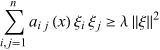 |
for every  and
 . If
 ,
 , and
 , then attaining its nonnegative maximum
over
 at an interior point forces
 to be constant throughout
 . If
 ,
the maximum need not be nonnegative (Gilbarg and Trudinger
2001, Carlotto 2021). Here
 means that the second partial
derivatives are continuous.
For  and
 continuous on the closure
of
 , the weak maximum principle bounds
 by its boundary values. The strong
principle adds the rigidity conclusion at an interior maximum.
Applied to
 , it gives the corresponding minimum
principle for
 . A harmonic
function is a basic example, with
 the Laplacian.
