


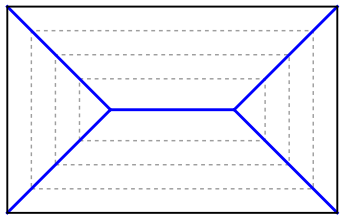
The straight skeleton of a simple polygon is obtained by moving every polygon edge inward, parallel to itself and at unit speed, and recording the paths traced by the polygon vertices as the shrinking wavefront changes combinatorially. These paths form a straight-line graph in the polygon interior. For a simple polygon in general position, the straight skeleton is a tree whose leaves are the original vertices.
For the rectangle illustrated above, the inward-moving wavefronts remain rectangles until the upper and lower edges meet. Each corner traces an angle bisector, producing the four diagonal segments. At the final event, the upper and lower wavefront edges meet along the central line segment. The resulting straight skeleton is shown in blue.
Unlike the medial axis, which is defined by equal distances from boundary points and can contain curved arcs, the straight skeleton consists entirely of line segments. It is used to construct polygonal roofs and parallel curves.
