

A Stoneham number is a number  of the form
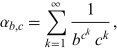 |
where  are relatively prime positive
integers. Allowing
are relatively prime positive
integers. Allowing  and
and  not to be relatively prime gives the generalized
Stoneham numbers. Stoneham (1973) proved that
not to be relatively prime gives the generalized
Stoneham numbers. Stoneham (1973) proved that  is
is  -normal whenever
  is an odd prime and
  is a primitive root of
  . Bailey and Crandall (2002) showed
that
. Bailey and Crandall (2002) showed
that  is normal whenever
  and
and  are relatively prime.
A project using ChatGPT-6 Astra reported the more general criterion that  is
is  -normal iff
some prime divisor of
-normal iff
some prime divisor of  does not divide
  (VibeMathed 2026a). If every prime
divisor of
(VibeMathed 2026a). If every prime
divisor of  divides
  ,
the digit 0 instead has limiting frequency 1. In particular,
,
the digit 0 instead has limiting frequency 1. In particular,
 is not normal
in base 6 even though neither 6 nor 4 divides the other,
giving a negative answer to Bailey and Crandall's (2002) mutual-nondivisibility question.
ChatGPT-6 Astra reportedly found the counterexample
and criterion, and wrote the Lean formalization. As of Sep. 15, 2026, the Lean
sources had passed the project's continuous integration, but independent specialist
review and a definitive priority check had not been reported.
is not normal
in base 6 even though neither 6 nor 4 divides the other,
giving a negative answer to Bailey and Crandall's (2002) mutual-nondivisibility question.
ChatGPT-6 Astra reportedly found the counterexample
and criterion, and wrote the Lean formalization. As of Sep. 15, 2026, the Lean
sources had passed the project's continuous integration, but independent specialist
review and a definitive priority check had not been reported.
Bailey and Borwein (2012) asked whether the sum of two Stoneham numbers with the same base must be normal
in that base. A project using ChatGPT-6 Astra reported that
if  and
and  is relatively prime to both
  and
and  , then
  is
is  -normal (VibeMathed 2026b).
ChatGPT-6 Astra reportedly selected the problem, proved the result, and produced
its Lean formalization. As of Sep. 13, 2026, the Lean sources had passed the
project's continuous integration and guarded checks, and VibeMathed had compared
the statement with Bailey and Borwein's question. The Lean build had not been independently
repeated, and independent specialist review of the proof had not been reported.
-normal (VibeMathed 2026b).
ChatGPT-6 Astra reportedly selected the problem, proved the result, and produced
its Lean formalization. As of Sep. 13, 2026, the Lean sources had passed the
project's continuous integration and guarded checks, and VibeMathed had compared
the statement with Bailey and Borwein's question. The Lean build had not been independently
repeated, and independent specialist review of the proof had not been reported.

 -Normality in the Rational
Fractions with Applications to Normal Numbers." Acta Arith. 22,
277-286, 1973.VibeMathed. "Bailey-Crandall's Mutual-Nondivisibility
Question for Stoneham Numbers." Sep. 12, 2026a.
-Normality in the Rational
Fractions with Applications to Normal Numbers." Acta Arith. 22,
277-286, 1973.VibeMathed. "Bailey-Crandall's Mutual-Nondivisibility
Question for Stoneham Numbers." Sep. 12, 2026a.