

A stochastic integral is an integral whose integrand, integrator, or both are stochastic processes
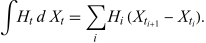
(Durrett 1996). It is commonly written  . For a simple process taking the random
variable
. For a simple process taking the random
variable  on the interval
 ![(t_i,t_(i+1)]](/images/equations/StochasticIntegral/Inline3.svg) ,
a basic definition is
,
a basic definition is
 |
The construction is then extended by a specified mode of convergence under hypotheses on  and
and  .
.
Different endpoint conventions or limiting procedures can produce different stochastic integrals. When  is a Wiener process and
  uses information available at the left endpoint, the construction
gives the Ito integral (Kendall 2005). Special definitions
are needed because sample paths such as those of a Wiener process typically do not
have bounded variation, so ordinary Stieltjes
integration does not apply.
uses information available at the left endpoint, the construction
gives the Ito integral (Kendall 2005). Special definitions
are needed because sample paths such as those of a Wiener process typically do not
have bounded variation, so ordinary Stieltjes
integration does not apply.
