


A squared torus is a torus tiled by finitely many squares. The torus is regarded as a rectangle with opposite sides identified by translations, so a tile crossing one side continues at the opposite side. The squaring is called perfect when all the squares have different side lengths, and its order is the number of squares.
The opposite sides are identified without stretching the original rectangle, so its tiles retain their square geometry. Wrapping the diagram onto a doughnut-shaped ring torus, however, stretches some parts and compresses others. The resulting curved patches show which tiles meet, but do not preserve lengths or areas. Thus the tiles are squares in the planar geometry with opposite sides identified, even though their images on a ring torus do not look square.
This is a toroidal counterpart of a perfect square dissection. A Mrs. Perkins's quilt also dissects a square into smaller squares, but allows repeated side lengths and requires their greatest common divisor to be 1. For a squared torus, opposite sides of the fundamental domain are identified and tiles may cross its boundary.
Gambini (1999) constructed a perfect squared torus of order 24 with a  square as its fundamental
domain.
square as its fundamental
domain.
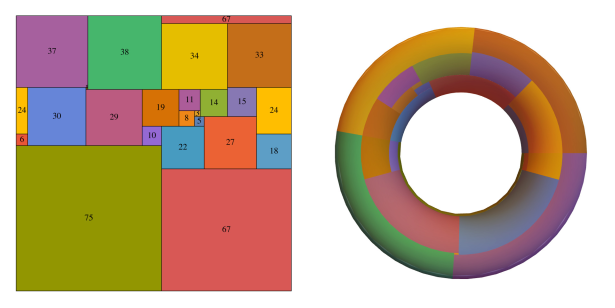
S. Anderson (pers. comm., Sep. 10, 2026) found the example illustrated above, of order 22 with a  square as its fundamental
domain. In these constructions the tile sides are parallel to the sides of the
fundamental domain. Anderson's example has
both smaller side length and lower order than Gambini's, but does not establish a
minimum order among perfect squared tori with a square fundamental domain and tile sides parallel to
its sides. Anderson's example consists of squares of sides
1, 3, 5, 6, 8, 10, 11, 14, 15, 18, 19, 22, 24, 27, 29, 30, 33, 34, 37, 38, 67, and
75. The squares of sides 24 and 67 cross the left-right
and top-bottom boundaries, respectively, so the planar diagram has 24 pieces representing
22 squares on the torus.
square as its fundamental
domain. In these constructions the tile sides are parallel to the sides of the
fundamental domain. Anderson's example has
both smaller side length and lower order than Gambini's, but does not establish a
minimum order among perfect squared tori with a square fundamental domain and tile sides parallel to
its sides. Anderson's example consists of squares of sides
1, 3, 5, 6, 8, 10, 11, 14, 15, 18, 19, 22, 24, 27, 29, 30, 33, 34, 37, 38, 67, and
75. The squares of sides 24 and 67 cross the left-right
and top-bottom boundaries, respectively, so the planar diagram has 24 pieces representing
22 squares on the torus.
Gardner (1966, 1977) asked readers how completely a  square could be packed
using the 24 squares having side lengths 1, 2, ..., 24.
The number 70 is the side length of the containing square,
not the order of the dissection. A perfect dissection, if one existed, would have
order 24. Although
square could be packed
using the 24 squares having side lengths 1, 2, ..., 24.
The number 70 is the side length of the containing square,
not the order of the dissection. A perfect dissection, if one existed, would have
order 24. Although
 |
no perfect planar tiling exists (Bitner and Reingold 1975, Sgall et al. 2024). Gardner reported receiving about 250 submissions. The best left an area of 49 uncovered
by omitting the  square. In contrast, identifying opposite sides permits the
following perfect squared torus.
square. In contrast, identifying opposite sides permits the
following perfect squared torus.
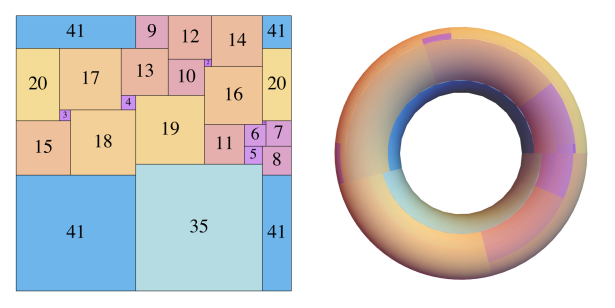
S. Anderson (Pegg 2026) subsequently found a perfect squared torus of the same order 22 with a  square as its fundamental
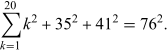
domain. Its squares have side lengths 1, 2, ..., 20,
35, and 41, satisfying
square as its fundamental
domain. Its squares have side lengths 1, 2, ..., 20,
35, and 41, satisfying
 |
The coordinates give an exact tiling with no gaps or overlaps after opposite sides are identified. This improves the side length of Anderson's
 example without reducing
its order or establishing minimality.
example without reducing
its order or establishing minimality.
The catalog compiled by G. Morley and reproduced by Anderson (n.d.) includes squared tori whose tiles are not parallel to the sides of the fundamental
domain, including a perfect example of order 2 with a  square as its fundamental
domain. These belong to a broader class than the constructions with tile sides
parallel to the sides of the square fundamental
domain described above.
square as its fundamental
domain. These belong to a broader class than the constructions with tile sides
parallel to the sides of the square fundamental
domain described above.

 Pegg, E. Jr. Mathematical Games.
Episode 45: "Filling Space with Similar Parts." Sep. 24, 2026.
Pegg, E. Jr. Mathematical Games.
Episode 45: "Filling Space with Similar Parts." Sep. 24, 2026.  Square with Consecutive Squares." In 12th
International Conference on Fun with Algorithms (FUN 2024). Leibniz International
Proceedings in Informatics 291, 28:1-28:16, 2024.
Square with Consecutive Squares." In 12th
International Conference on Fun with Algorithms (FUN 2024). Leibniz International
Proceedings in Informatics 291, 28:1-28:16, 2024.