A Mrs. Perkins's quilt is a dissection of an square ,
for a positive integer squares with positive
integer side lengths whose greatest common
divisor is 1. Such a dissection is called prime.
For square is included as the trivial quilt.
The name comes from Dudeney's problem 173 (Dudeney 1917), which asks for a solution
with perfect square dissection , the
component squares need not have different sizes.
The smallest numbers of squares needed to create prime dissections of an A005670 ), the first few of which
are illustrated above.
On October 9-10, L. Gay (pers. comm. to E. Pegg, Jr.) discovered 18-square quilts for side lengths 88, 89, and 90, thus beating all previous records. The following
table summarizes the best known numbers of squares
1 1 4 2 6 3 7 4 8 5 9 6, 7 10 8,
9 11 10-13 12 14-17 13 18-23 14 24-29 15 30-39,41 16 40, 42-53 17 54-70 18 71-91 19 92-120,
122, 126 20 121, 123-125,
127-154, 157, 158 21 155,
156, 159-197, 199-204, 209, 216 22 198, 205-208, 210-215, 217-252, 254-257, 260, 262, 263, 265 23 253, 258, 259, 261, 264, 266-332,
334-339, 341, 342, 344, 346, 349, 352, 364 24 333, 340, 343, 345, 347, 348, 350, 351, 353-363, 365-432, 434-436, 438,
440-444, 450, 453, 456
A squared torus gives a related problem with opposite sides of a rectangle identified, allowing squares
to cross the boundary. Such a squaring is perfect when all its squares
have different side lengths.
See also No-Touch Dissection ,
Nowhere-Neat Dissection ,
Perfect Rectangle ,
Perfect
Square Dissection ,
Squared Torus
Explore with Wolfram|Alpha
References Borwein, J. and Bailey, D. Mathematics by Experiment: Plausible Reasoning in the 21st Century. Conway, J. H. "Mrs. Perkins's
Quilt." Proc. Cambridge Phil. Soc. 60 , 363-368, 1964. Conway,
J. H. "Re: [math-fun] Mrs. Perkins Quilt - Orders 89, 90 improved over
UPIG." math-fun@mailman.xmission.com mailing list. October 10, 2003. Croft,
H. T.; Falconer, K. J.; and Guy, R. K. §C3 in Unsolved
Problems in Geometry. Devincentis,
J. "Square the Square." http://members.bellatlantic.net/~devjoe/sqsq/ . Dudeney,
H. E. Problem 173 in Amusements
in Mathematics. Dudeney, H. E. Problem
177 in 536
Puzzles & Curious Problems. Duijvestijn,
A. J. W. "Electronic Computation of Squared Rectangles." Philips
Res. Reports 17 , 523-613, 1962. Gardner, M. "Mrs. Perkins'
Quilt and Other Square-Packing Problems." Ch. 11 in Mathematical
Carnival: A New Round-Up of Tantalizers and Puzzles from Scientific American. Guy, R. K. "Mrs. Perkins's Quilt."
Draft, Dec. 4. 2003. Littlewood, J. E. Littlewood's
Miscellany. Pegg,
E. Jr. "MathPuzzle: List of Best Solutions." Jan. 13, 2004. https://www.mathpuzzle.com/perkinsbestquilts.txt . Pegg,
E. Jr. "Math Games: Square Packing." Dec. 1, 2003. https://www.mathpuzzle.com/MAA/06-Square%20Packing/mathgames_12_01_03.html . Scherer,
K. "Square the Square." http://karl.kiwi.gen.nz/prosqtsq.html . Sloane,
N. J. A. Sequence A005670 /M3267
in "The On-Line Encyclopedia of Integer Sequences." Trustrum,
G. B. "Mrs. Perkins's Quilt." Proc. Cambridge Phil. Soc. 61 ,
7-11, 1965. Wynn, E. "Exhaustive Generation of 'Mrs. Perkins's Quilt'
Square Dissections for Low Orders." Disc. Math. 334 , 38-47, 2014.
https://doi.org/10.1016/j.disc.2014.06.022 . Referenced
on Wolfram|Alpha Mrs. Perkins's Quilt
Cite this as:
Weisstein, Eric W. "Mrs. Perkins's Quilt."
From MathWorld https://mathworld.wolfram.com/MrsPerkinssQuilt.html
Subject classifications More... Less...


 square,
for a positive integer
 , into squares with positive
integer side lengths whose greatest common
divisor is 1. Such a dissection is called prime.
For
 ,
the undivided unit square is included as the trivial quilt.
The name comes from Dudeney's problem 173 (Dudeney 1917), which asks for a solution
with
 .
Unlike a perfect square dissection, the
component squares need not have different sizes.
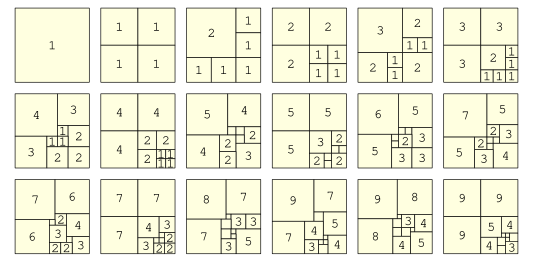
 quilt for
 , 2, ... are 1, 4, 6, 7, 8, 9, 9, 10, 10, 11, 11, 11, 11,
12, ... (OEIS A005670), the first few of which
are illustrated above.
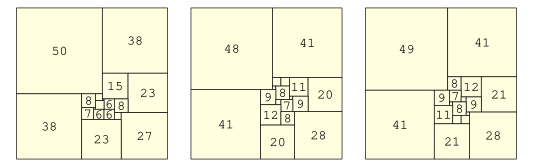
 for various side lengths
 . The values for
 are proved minimal (Wynn 2014). Conway (1964) gave
an upper bound of order
 , which Trustrum (1965) improved to order
 . More explicitly,
 for
 (Wynn 2014).


