


Square tilings are the subject of a number of interesting results.
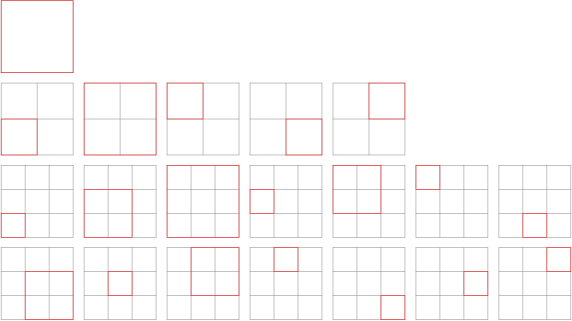
For a nonnegative integer  , consider an
 square grid of unit
cells and squares whose vertices are grid points. The
total number of such squares having sides parallel to the axes is the square
pyramidal number
 |
whose values are given for  , 2, ... by 1, 5, 14, 30, 55, 91, ... (OEIS A000330).
This is true because the
 square grid contains
 vertices corresponding
to the lower left corner of a
 square for each
 , ...,
 .
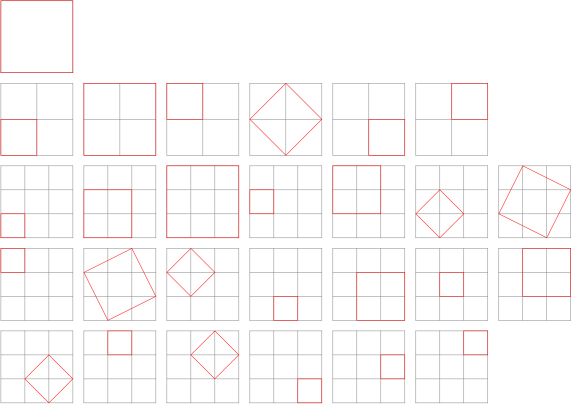
The total number of squares in any orientation whose vertices are grid points in the  square grid is the 4-dimensional pyramidal
number
 |
whose values are given for  , 2, ... by 1, 6, 20, 50, 105, 196, ... (OEIS A002415).
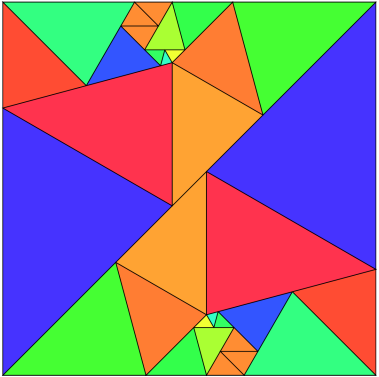
Laczkovich (1990) proved that there are exactly three shapes of non-right triangles that tile the square using finitely many
similar copies, namely those with angles  ,
 , and
 (Stein and Szabó 1994), i.e.,
 ,
 , and
 .
The proof of Laczkovich (1990) involved thousands of  triangles, but included no
explicit illustration. A construction involving 32
 triangles (14 of which are
distinct), a number believed to be minimal and which is illustrated above, was subsequently
made by Tom Sirgedas (Pegg 2025).
Right triangles with edge lengths in the proportion 1:2: and having no two such triangles the same size also tile the square.
The best known solution has 8 triangles (Berlekamp 1999).

 Pegg, E. Jr. "The
Tom Sirgedas
 -
 -
 Square Dissection." Wolfram Community.
Mar. 4, 2025.