The only numbers which are simultaneously square and square pyramidal (the cannonball
problem) are
and ,
corresponding to
and
(Ball and Coxeter 1987, p. 59; Ogilvy 1988; Dickson 2005, p. 25), as conjectured
by Lucas (1875), partially proved by Moret-Blanc (1876) and Lucas (1877), and proved
by Watson (1918). The problem requires solving the Diophantine
equation
(4)
(Guy 1994, p. 147). Watson (1918) gave an almost elementary proof, disposing of most cases by elementary means, but resorting to the use of elliptic functions for one pesky case. Entirely elementary proofs have been given by Ma (1985) and Anglin (1990).
The only solutions with positive integers
and
are ,
(5, 10), (6, 13), and (85, 645) (Guy 1994, p. 147), corresponding to the positive
common values 1, 55, 91, 208335.
Beukers and Top (1988, p. 204) studied the problem of finding solutions via integral points on an elliptic curve and found
that the only solution with positive integers
and
is the trivial .
Anglin, W. S. "The Square Pyramid Puzzle." Amer. Math. Monthly97, 120-124, 1990.Anglin, W. S.
The
Queen of Mathematics: An Introduction to Number Theory. Dordrecht, Netherlands:
Kluwer, 1995.Baker, A. and Davenport, H. "The Equations and ." Quart. J. Math. Ser. 220, 129-137,
1969.Ball, W. W. R. and Coxeter, H. S. M. Mathematical
Recreations and Essays, 13th ed. New York: Dover, p. 59, 1987.Beukers,
F. and Top, J. "On Oranges and Integral Points on Certain Plane Cubic Curves."
Nieuw Arch. Wisk.6, 203-210, 1988.Conway, J. H.
and Guy, R. K. The
Book of Numbers. New York: Springer-Verlag, pp. 47-50, 1996.Dickson,
L. E. History
of the Theory of Numbers, Vol. 2: Diophantine Analysis. New York: Dover,
2005.Guy, R. K. "Figurate Numbers." §D3 in Unsolved
Problems in Number Theory, 2nd ed. New York: Springer-Verlag, pp. 147-150,
1994.Kanagasabapathy, P. and Ponnudurai, T. "The Simultaneous Diophantine
Equations
and ."
Quart. J. Math. Ser. 226, 275-278, 1975.Ljunggren, W.
"New Solution of a Problem Posed by E. Lucas." Nordisk Mat. Tidskrift34,
65-72, 1952.Lucas, É. Question 1180. Nouv. Ann. Math. Ser.
214, 336, 1875.Lucas, É. Solution de Question 1180.
Nouv. Ann. Math. Ser. 216, 429-432, 1877.Ma, D. G.
"An Elementary Proof of the Solution to the Diophantine Equation ." Sichuan Daxue Xuebao4,
107-116, 1985.Moret-Blanc, M. Question 1180. Nouv. Ann. Math. Ser.
215, 46-48, 1876.Ogilvy, C. S. and Anderson, J. T.
Excursions
in Number Theory. New York: Dover, pp. 77 and 152, 1988.Sloane,
N. J. A. Sequence A000330/M3844
in "The On-Line Encyclopedia of Integer Sequences."Watson,
G. N. "The Problem of the Square Pyramid." Messenger Math.48,
1-22, 1918.Wolf, T. "The Puzzle." https://web.archive.org/web/20020111140015/http://home.tiscalinet.ch:80/t_wolf/tw/misc/squares.html.


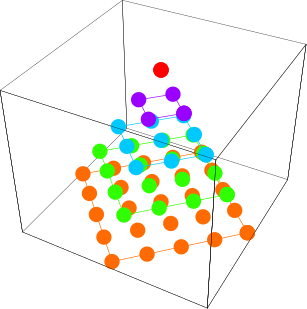

 , corresponding to a configuration of points which form a square pyramid (or sometimes, simply a pyramidal
number). The first few are 1, 5, 14, 30, 55, 91, 140, 204, ... (OEIS A000330).
The generating function for square pyramidal
numbers is
, corresponding to a configuration of points which form a square pyramid (or sometimes, simply a pyramidal
number). The first few are 1, 5, 14, 30, 55, 91, 140, 204, ... (OEIS A000330).
The generating function for square pyramidal
numbers is


 is the
  th
triangular number.
th
triangular number.
 and square pyramidal
  (the cannonball
problem) are
(the cannonball
problem) are  and
and  ,
corresponding to
,
corresponding to  and
and  (Ball and Coxeter 1987, p. 59; Ogilvy 1988; Dickson 2005, p. 25), as conjectured
by Lucas (1875), partially proved by Moret-Blanc (1876) and Lucas (1877), and proved
by Watson (1918). The problem requires solving the Diophantine
equation
(Ball and Coxeter 1987, p. 59; Ogilvy 1988; Dickson 2005, p. 25), as conjectured
by Lucas (1875), partially proved by Moret-Blanc (1876) and Lucas (1877), and proved
by Watson (1918). The problem requires solving the Diophantine
equation

 and square pyramidal
  satisfy the Diophantine
equation
satisfy the Diophantine
equation




 and
and  are
are  ,
(5, 10), (6, 13), and (85, 645) (Guy 1994, p. 147), corresponding to the positive
common values 1, 55, 91, 208335.
,
(5, 10), (6, 13), and (85, 645) (Guy 1994, p. 147), corresponding to the positive
common values 1, 55, 91, 208335.
 and square pyramidal
  satisfy the Diophantine
equation
satisfy the Diophantine
equation

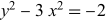 and
and 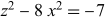 is the trivial
  .
.

 and
and  ." Quart. J. Math. Ser. 2 20, 129-137,
1969.Ball, W. W. R. and Coxeter, H. S. M.
." Quart. J. Math. Ser. 2 20, 129-137,
1969.Ball, W. W. R. and Coxeter, H. S. M.  and
and  ."
Quart. J. Math. Ser. 2 26, 275-278, 1975.Ljunggren, W.
"New Solution of a Problem Posed by E. Lucas." Nordisk Mat. Tidskrift 34,
65-72, 1952.Lucas, É. Question 1180. Nouv. Ann. Math. Ser.
2 14, 336, 1875.Lucas, É. Solution de Question 1180.
Nouv. Ann. Math. Ser. 2 16, 429-432, 1877.Ma, D. G.
"An Elementary Proof of the Solution to the Diophantine Equation
."
Quart. J. Math. Ser. 2 26, 275-278, 1975.Ljunggren, W.
"New Solution of a Problem Posed by E. Lucas." Nordisk Mat. Tidskrift 34,
65-72, 1952.Lucas, É. Question 1180. Nouv. Ann. Math. Ser.
2 14, 336, 1875.Lucas, É. Solution de Question 1180.
Nouv. Ann. Math. Ser. 2 16, 429-432, 1877.Ma, D. G.
"An Elementary Proof of the Solution to the Diophantine Equation  ." Sichuan Daxue Xuebao 4,
107-116, 1985.Moret-Blanc, M. Question 1180. Nouv. Ann. Math. Ser.
2 15, 46-48, 1876.Ogilvy, C. S. and Anderson, J. T.
." Sichuan Daxue Xuebao 4,
107-116, 1985.Moret-Blanc, M. Question 1180. Nouv. Ann. Math. Ser.
2 15, 46-48, 1876.Ogilvy, C. S. and Anderson, J. T.
 Puzzle."