

A snark superposition is a graph construction that starts with a connected cubic graph  and replaces its vertices and edges by cubic graph
multipoles called supervertices and superedges, respectively. Each supervertex
has three connectors, one for each incident edge of
and replaces its vertices and edges by cubic graph
multipoles called supervertices and superedges, respectively. Each supervertex
has three connectors, one for each incident edge of  , and each superedge is a graph
dipole. Joining corresponding connectors produces a cubic graph that retains
the incidence pattern of
, and each superedge is a graph
dipole. Joining corresponding connectors produces a cubic graph that retains
the incidence pattern of  (Máčajová and Škoviera 2021).
A snark superposition is proper if its base graph is a snark and every superedge is proper. A superedge is proper if, for every nowhere-zero  -flow on its graph dipole,
the total flow through each connector is nonzero. Every connected proper snark superposition
is a snark (Máčajová and Škoviera 2021).
-flow on its graph dipole,
the total flow through each connector is nonzero. Every connected proper snark superposition
is a snark (Máčajová and Škoviera 2021).
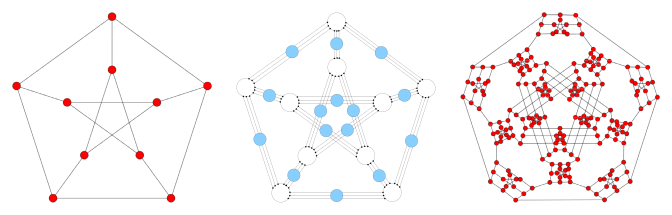
The Descartes snarks are early examples of proper snark superposition. Their base graph is the Petersen
graph, their supervertices are 9-cycles, and their superedges are proper  -graph
dipoles obtained by deleting two vertices at distance 2 from the Petersen
graph (Descartes 1948, Máčajová and Škoviera 2021).
-graph
dipoles obtained by deleting two vertices at distance 2 from the Petersen
graph (Descartes 1948, Máčajová and Škoviera 2021).
