


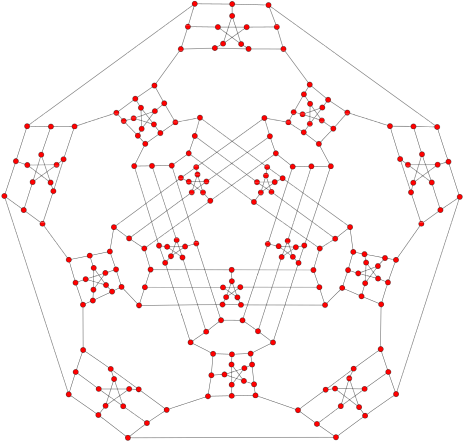
The Descartes snarks are a set of (strong) snarks on 210 vertices and 315 edges discovered by William Tutte writing under the pseudonym Blanche Descartes (Descartes 1948; Holton and Sheehan 1993, pp. 93-97). The Descartes snark illustrated above is implemented in the Wolfram Language as GraphData["DescartesSnark1"].
Descartes snarks are obtained by replacing each vertex of the Petersen graph with a 9-cycle graph and each edge with a graph related to the Petersen graph. This procedure can be performed in a number of ways, leading to multiple distinct Descartes snarks.
After quotienting by the side-preserving graph automorphism of each edge-replacement graph, there are 18 attachment states for each of the 15 edges. Thus, before quotienting by the global symmetries of the Petersen graph, the number of side-reduced labeled attachment assignments is
 |
A complete orbit calculation using the Cauchy-Frobenius lemma (also known as Burnside's lemma) and the 120 graph
automorphisms of the Petersen graph shows that
the construction yields exactly  graph isomorphism classes
of Descartes snarks, where
graph isomorphism classes
of Descartes snarks, where
 |
The construction decomposition is intrinsic: the only 5-cycles are the two internal 5-cycles in each  -graph dipole. Their vertex incidences recover the 15 dipoles, after which
the remaining vertices induce the ten 9-cycles.
Therefore
-graph dipole. Their vertex incidences recover the 15 dipoles, after which
the remaining vertices induce the ten 9-cycles.
Therefore  is also the unrestricted graph isomorphism class
count.
is also the unrestricted graph isomorphism class
count.
Every resulting graph has girth 5 and cyclic edge connectivity 4. A cyclic
edge cut of size 4 is obtained from any graph
dipole together with its two incident three-vertex
blocks of 9-cycle vertices,
while an exact minimization over all attachment states shows that no nontrivial edge cut has fewer than four edges.
Together with the proper-superposition result below, this proves that all  graphs are strong snarks;
none is merely a weak snark, and no attachment state
fails to produce a snark.
graphs are strong snarks;
none is merely a weak snark, and no attachment state
fails to produce a snark.
Máčajová and Škoviera (2021) interpret this construction as a proper snark superposition of the Petersen graph: the 9-cycles
are supervertices, while the edge-replacement graphs are proper  -graph dipoles obtained
from the Petersen graph by deleting two vertices
at graph distance 2. More generally, every connected
proper snark superposition is itself a snark.
-graph dipoles obtained
from the Petersen graph by deleting two vertices
at graph distance 2. More generally, every connected
proper snark superposition is itself a snark.
The Descartes snark is a  cyclic group graph.
