

The skewed generalized  distribution is a family of continuous statistical
distributions with independently adjustable tail weight, peakedness, and asymmetry.
One convenient nonstandardized parameterization begins with the symmetric generalized
distribution is a family of continuous statistical
distributions with independently adjustable tail weight, peakedness, and asymmetry.
One convenient nonstandardized parameterization begins with the symmetric generalized
 probability density function
![g_(p,q)(y)=p/(2q^(1/p)B(1/p,q))[1+(|y|^p)/q]^(-(q+1/p)),](/images/equations/SkewedGeneralizedtDistribution/NumberedEquation1.svg) |
(1)
|
where  and
and  is the beta function. For location
  , scale
  , and asymmetry parameter
  , put
, put 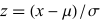 and define
 |
(2)
|
The unequal left and right scales preserve total probability because the two halves have masses  and
and  . Thus
  controls left-right asymmetry but is not itself the standardized
skewness.
controls left-right asymmetry but is not itself the standardized
skewness.
When  ,
the distribution reduces to a symmetric generalized
,
the distribution reduces to a symmetric generalized  distribution. After reparameterization or limiting choices
of
distribution. After reparameterization or limiting choices
of  and
and  ,
the family includes the Student's t-distribution,
normal distribution, Cauchy
distribution, and Laplace distribution.
Theodossiou (1998) introduced a standardized parameterization for modeling skewness
and heavy tails in financial data.
,
the family includes the Student's t-distribution,
normal distribution, Cauchy
distribution, and Laplace distribution.
Theodossiou (1998) introduced a standardized parameterization for modeling skewness
and heavy tails in financial data.
