


A scutoid is a solid-like cell shape occurring between two roughly parallel surfaces in which the polygonal cross section changes its adjacency pattern from one surface to the other. This change is produced by at least one vertex away from the two boundary surfaces and an associated nonprismatic face. Scutoids therefore allow neighboring cells to exchange adjacency while filling a curved three-dimensional layer.
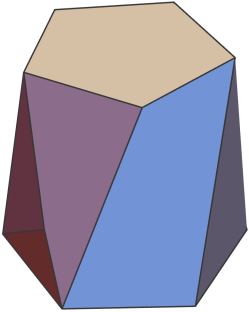
A schematic scutoid with pentagonal and hexagonal ends and an intervening vertex is illustrated above.
The term was introduced by Gómez-Gálvez et al. (2018) in studying the packing of epithelial cells. Unlike a prism, a scutoid need not have corresponding vertices or the same polygonal face at its two ends.
