


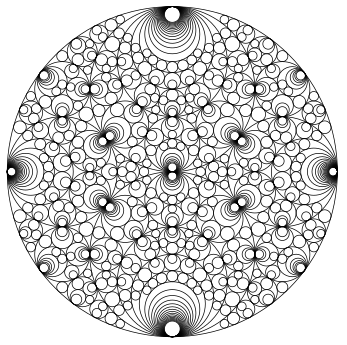
The Schmidt algorithm is a complex continued fraction algorithm introduced by A. L. Schmidt. It produces Gaussian
rational approximations, or ratios of Gaussian integers,
to a complex number by successively locating the
number in a nested sequence of regions bounded by line
segments and circular arcs. Each region is associated
with a Möbius transformation whose
coefficients are Gaussian integers; the products
of the corresponding  matrices determine the convergents.
Unlike the nearest Gaussian integer algorithm, the Schmidt construction is based on a geometrically refined partition of the complex plane. The nested regions shrink to the represented complex number, and their boundaries form families of tangent circles and lines often called Schmidt circles.
