

An SIR model is a compartmental epidemiological model for the time evolution of a closed population divided into susceptible people  , infectious people
  , and removed people
  . Depending on the model, removed people may have recovered
with immunity, been isolated, or died. One of the simplest SIR models is the Kermack-McKendrick
model.
. Depending on the model, removed people may have recovered
with immunity, been isolated, or died. One of the simplest SIR models is the Kermack-McKendrick
model.
A common generalization allows the transmission and removal rates to vary with time, giving
 |  |  |
(1)
|
 |  |  |
(2)
|
 |  |  |
(3)
|
Since the three derivatives sum to 0, the total population is conserved,
 |
(4)
|
Estimating the functions  and
and  from observations of
  and
and  is a coefficient-identification inverse
problem (Marinov et al. 2014, Marinov and Marinova 2020).
is a coefficient-identification inverse
problem (Marinov et al. 2014, Marinov and Marinova 2020).
An intervention can be modeled by replacing  with
with  , where the control
  takes values between 0 and 1. For the constant-rate SIR
model with
takes values between 0 and 1. For the constant-rate SIR
model with  ,
Britton and Leskelä (2023) proved that among piecewise
continuous controls satisfying
,
Britton and Leskelä (2023) proved that among piecewise
continuous controls satisfying 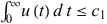 and
and  , where
  and
and  , total incidence (the fraction of initially
susceptible people eventually infected) is minimized by applying the maximum control
, total incidence (the fraction of initially
susceptible people eventually infected) is minimized by applying the maximum control
 on one interval of length
  . The optimal starting time
is unique.
. The optimal starting time
is unique.
The Season 1 episode "Vector" (2005) of the television crime drama NUMB3RS features SIR models.
