

The Kermack-McKendrick model is an SIR model for the number of people infected with a contagious illness in a closed population over time. It was proposed to explain the rapid rise and fall in the number of infected patients observed in epidemics such as the plague (London 1665-1666, Bombay 1906) and cholera (London 1865). It assumes that the population size is fixed (i.e., no births, deaths due to disease, or deaths by natural causes), incubation period of the infectious agent is instantaneous, and duration of infectivity is same as length of the disease. It also assumes a completely homogeneous population with no age, spatial, or social structure.
The model consists of a system of three coupled nonlinear ordinary differential equations,
 |  |  |
(1)
|
 |  |  |
(2)
|
 |  |  |
(3)
|
where  is time,
  is the number of susceptible people,
  is the number of people infected,
  is the number of people who have recovered and developed
immunity to the infection,
is the number of people who have recovered and developed
immunity to the infection,  is the infection rate, and
  is the recovery rate. The total population
 |
(4)
|
is constant.
With the convention above, in which  ,
,  , and
, and  are population counts and the incidence term is
  , the basic reproduction number for an initially completely
susceptible population is
, the basic reproduction number for an initially completely
susceptible population is
 |
(5)
|
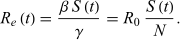
It is the expected number of secondary infections caused by a single primary infection in a completely susceptible population. The corresponding effective reproduction
number at time  is
is
 |
(6)
|
(Marinov et al. 2023). If  ,
,  , and
, and  instead denote fractions of the population and
  is correspondingly rescaled, the same model is written
with
is correspondingly rescaled, the same model is written
with  ,
and the formulas are
,
and the formulas are  and
and  .
.
When  ,
the number of infected people decreases (
,
the number of infected people decreases ( ). When
  , it increases (
 ). The formulas above apply only to the basic Kermack-McKendrick
model. Alternative SIR models can have different epidemic
thresholds.
). The formulas above apply only to the basic Kermack-McKendrick
model. Alternative SIR models can have different epidemic
thresholds.
The Kermack-McKendrick model was brought back to prominence after decades of neglect by Anderson and May (1979). More complicated versions of the Kermack-McKendrick model that better reflect the actual biology of a given disease are often used.
