

The SET game is a card game in which players identify triples satisfying an all-same-or-all-different rule for each of four attributes. Every card specifies a number of symbols, a shape,
a color, and a shading, with three possibilities for each attribute. The deck has
one card for every combination, so it contains  cards. Three distinct cards form a SET when, separately
for each attribute, the three values are either all equal
or all different (Davis and Maclagan 2003).
Assigning 0, 1, and 2 to the values of each attribute identifies the cards with vectors in  , where
 is the finite field with
three elements. A triple of distinct cards
 ,
 , and
 is a SET iff
 |
For one coordinate, the three values have sum zero modulo 3 exactly when they are all equal or all different.
Thus SETs are precisely the three-point lines of the affine space  (Davis and Maclagan 2003).
Any two distinct cards determine a unique third card,  , that completes a SET. There are therefore
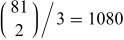 SETs in the full deck, since each triple contains three unordered pairs. A collection
containing no SET corresponds to a cap set. Such a collection
can have at most 20 cards, and collections of 20 with no SET exist (Davis and Maclagan
2003).
The maximum number of SET triples in a 12-card collection is 14 (de Bruijn 2002, Stevens et al. 2026). Stevens et al. (2026) give a separate proof using
projection to  and a finite search.
The algebraic description also motivates variants using other groups. In these variants, selected distinct group elements are combined using the group operation to obtain the identity element. For a non-Abelian group, the selected order can matter (Hsu et al. 2021).
