


Rule 90 is one of the elementary cellular automaton rules introduced by Stephen Wolfram in 1983 (Wolfram 1983, 2002). It
specifies the next color in a cell, depending on its color and its immediate neighbors.
Its rule outcomes are encoded in the binary representation
 . This rule is illustrated
above together with the evolution of a single black cell it produces after 15 steps
(Wolfram 2002, p. 55).
Starting with a single black cell on an otherwise white infinite row, successive generations beginning at generation 0 are given by interpreting the numbers 1, 5, 17, 85, 257, 1285, 4369, 21845, ... (OEIS A038183) in binary, namely as 1, 101, 10001, 1010101, 100000001, ... (OEIS A070886).
Rule 90 is amphichiral, and its complement is rule 165.

The fractal produced by this rule was described by Sierpiński (1915). Finite versions of its nested pattern appear in Italian art from the 13th
century (Wolfram 2002, p. 43).
It is therefore also known as the Sierpiński
sieve, Sierpiński gasket, or Sierpiński triangle. For integers  , the binomial
coefficient
 mod 2 is 1 iff every 1 in the binary
representation of
 occurs in the same position in that of
 . In Pascal's triangle
mod 2, each interior coefficient is the XOR of the two coefficients
immediately above it. Moreover, coloring all odd numbers
black and even numbers white in Pascal's
triangle produces a Sierpiński sieve
(Guy 1990; Wolfram 2002, p. 870).
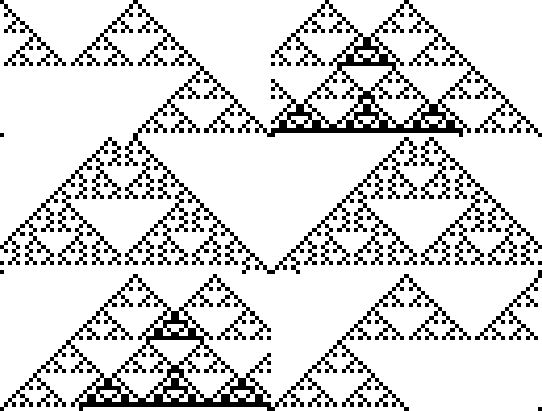
Rule 90 is one of the eight additive elementary cellular automata under addition modulo 2 (the XOR operation; Wolfram 2002, p. 952).
